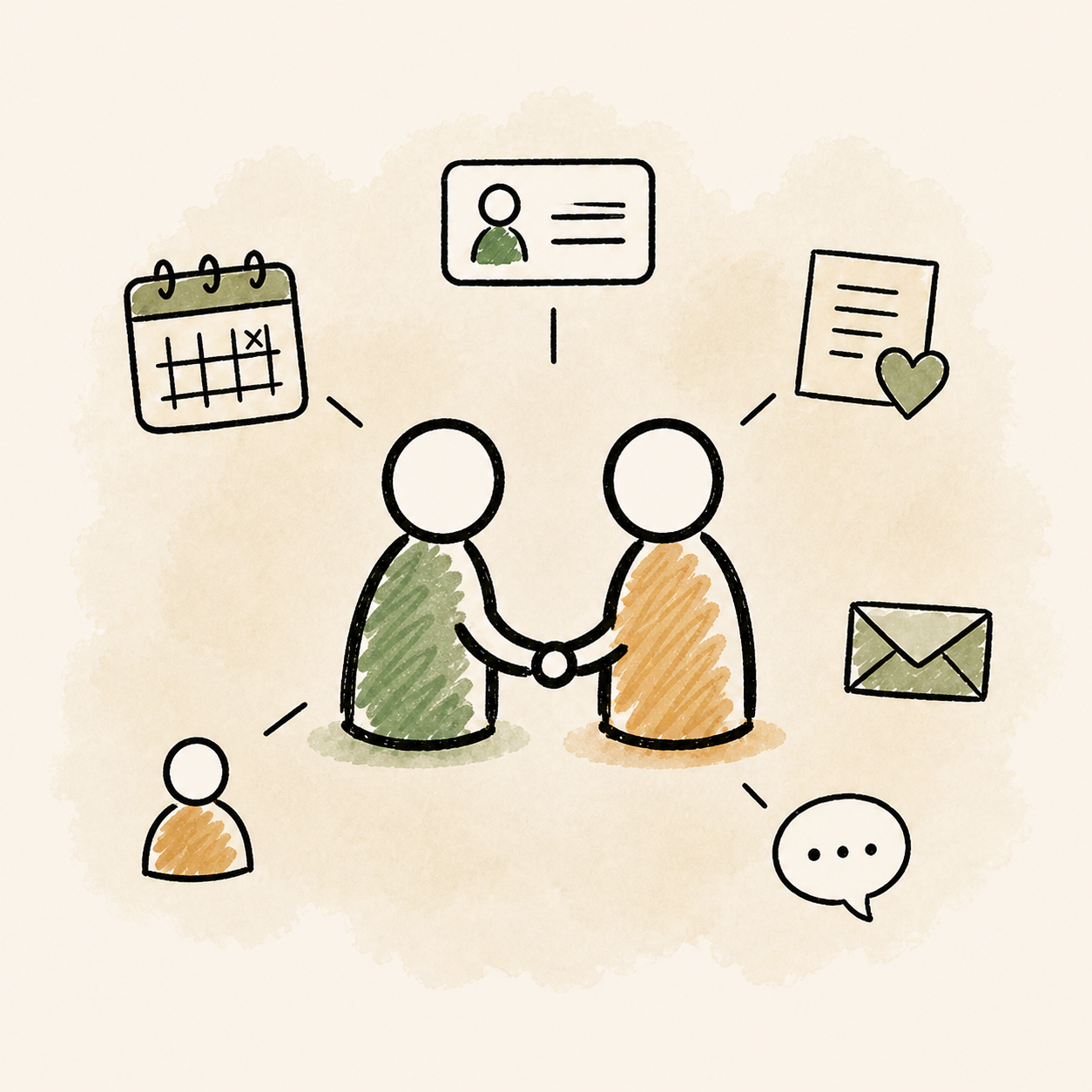
Most professionals don't struggle to meet people. They struggle to stay in touch consistently, which is why a personal CRM becomes necessary long after the first connection is made. If there isn't a system to maintain them, the truth is, relationships tend to fade away.
That's where Goodword approaches things differently. Instead of treating a personal CRM solely as a database, it treats it as a layer of relationship intelligence that helps you understand who matters right now and why.
This is the real role of a personal CRM. It's not just a tool for organization, but a system for preserving context, timing, and trust across your network. And once you see it that way, it becomes clear why most professionals need one.
Anthropologist Robin Dunbar showed that humans can maintain roughly 150 relationships, yet most professionals exceed that quickly. The gap between capacity and reality is where relationships start to decay.
The problem isn't intent. People don't forget others on purpose; they lose track because context is fragmented across conversations, platforms, and time. Without a system, even meaningful relationships drift into silence.
Scattered contacts make this worse. When context lives in multiple places, you lose the thread of who someone is, what they care about, and why you connected in the first place.
The real job isn't organization; it's preserving three things most people lose: context, timing, and continuity.
Context means remembering what actually matters about someone, not just their role, but their priorities, transitions, and personal details. Without it, every interaction resets the relationship.
Timing is what turns a message into something meaningful. Reaching out at the right moment signals attention, while random outreach feels transactional.
Trust builds quietly through both. When you consistently show up with awareness, people feel remembered, and that's what strengthens relationships over time.
Most tools overcomplicate relationship management. The difference between something that works and something that gets abandoned comes down to a few core behaviors.
What matters is not what the system can do, but what it helps you do consistently:
The pattern is simple. Systems fail when they demand effort, and succeed when they make consistency easier than neglect.
Most people think they're choosing between different tools. In reality, they're choosing how much cognitive work they want to carry themselves.
Some systems do more of the thinking. They surface reminders, highlight changes, and suggest when to act. This reduces effort but also reduces control.
Others reflect your own structure. You define how relationships are organized, how often you reach out, and what matters. This offers flexibility, but requires discipline.
Then there are systems that create friction. These demand too much input, too much maintenance, or too much structure, and that's where abandonment starts.
Abandonment doesn't happen because people stop caring about relationships. It happens because the system stops fitting their behavior.
Overbuilding is the most common mistake. Trying to track everyone or capture everything creates an effort level that's impossible to sustain. Lack of integration is another failure point. When every update requires manual input, consistency breaks quickly.
The underlying issue is always the same: Systems fail when they feel like work, and succeed when they feel like a natural extension of how you already operate.
Consistency doesn't come from discipline alone, but from reducing the effort required to stay engaged. Start smaller by focusing on a limited group of people who matter right now, rather than trying to organize your entire network at once.
Build a rhythm that runs in the background. When follow-up becomes something you respond to instead of something you remember, the system starts to work.
Over time, small actions compound. A few notes, a few timely messages, and a few maintained connections create a network that stays active without constant effort.
A personal CRM isn't about managing contacts. It's about preventing relationship decay before it quietly costs you opportunities. The people who matter don't disappear because they stopped being relevant, but because you didn't have a system to stay present in their world.
The shift is simple but powerful. Stop thinking of networking as something you do occasionally, and start treating it as something you maintain consistently. A CRM for individuals works when it becomes part of your rhythm, not another task on your list.
This is exactly where Goodword fits. It helps you focus on the right relationships at the right time, so you can invest attention where it actually matters. Start building a system that keeps your relationships alive because that's where your next opportunity already is.
A personal CRM is a system that helps you manage and maintain relationships over time. It stores contact details, tracks interactions, and reminds you when to follow up so connections don't fade. Unlike a simple address book, it acts as a relationship management tool that preserves context and timing.
A personal CRM focuses on individuals and relationships, while business CRMs are designed for sales pipelines and teams. Personal CRM software prioritizes simplicity, follow-ups, and context instead of deals, revenue tracking, or automation workflows. The goal is not to close transactions but to consistently maintain professional relationships.
Anyone who relies on relationships for opportunities can benefit from a personal CRM. This includes founders, operators, consultants, and professionals with growing networks who want to stay intentional. If you've ever forgotten to follow up or lost touch with valuable contacts, a CRM for individuals can help solve that problem.
Yes, because the challenge isn't network size—it's consistency. Even with a small group of contacts, relationships weaken without regular interaction and context. A personal CRM ensures you invest attention where it matters, rather than relying on memory alone.
You should update it immediately after meaningful interactions. Adding a few quick notes after a conversation keeps the system accurate and useful over time. This small habit builds a detailed history that makes future outreach more natural and relevant.
The most important features are contact organization, follow-up reminders, and simple note-taking. Integrations with email and calendar also matter because they reduce manual work. A good relationship management tool focuses on reducing effort while increasing consistency.
Yes, because opportunities come from relationships, not isolated interactions. A personal CRM helps you stay top of mind, reconnect with dormant ties, and reach out at the right moment. If you want a system that makes staying in touch effortless, start by building a simple follow-up habit and let the tool support it.

.svg)





.png)