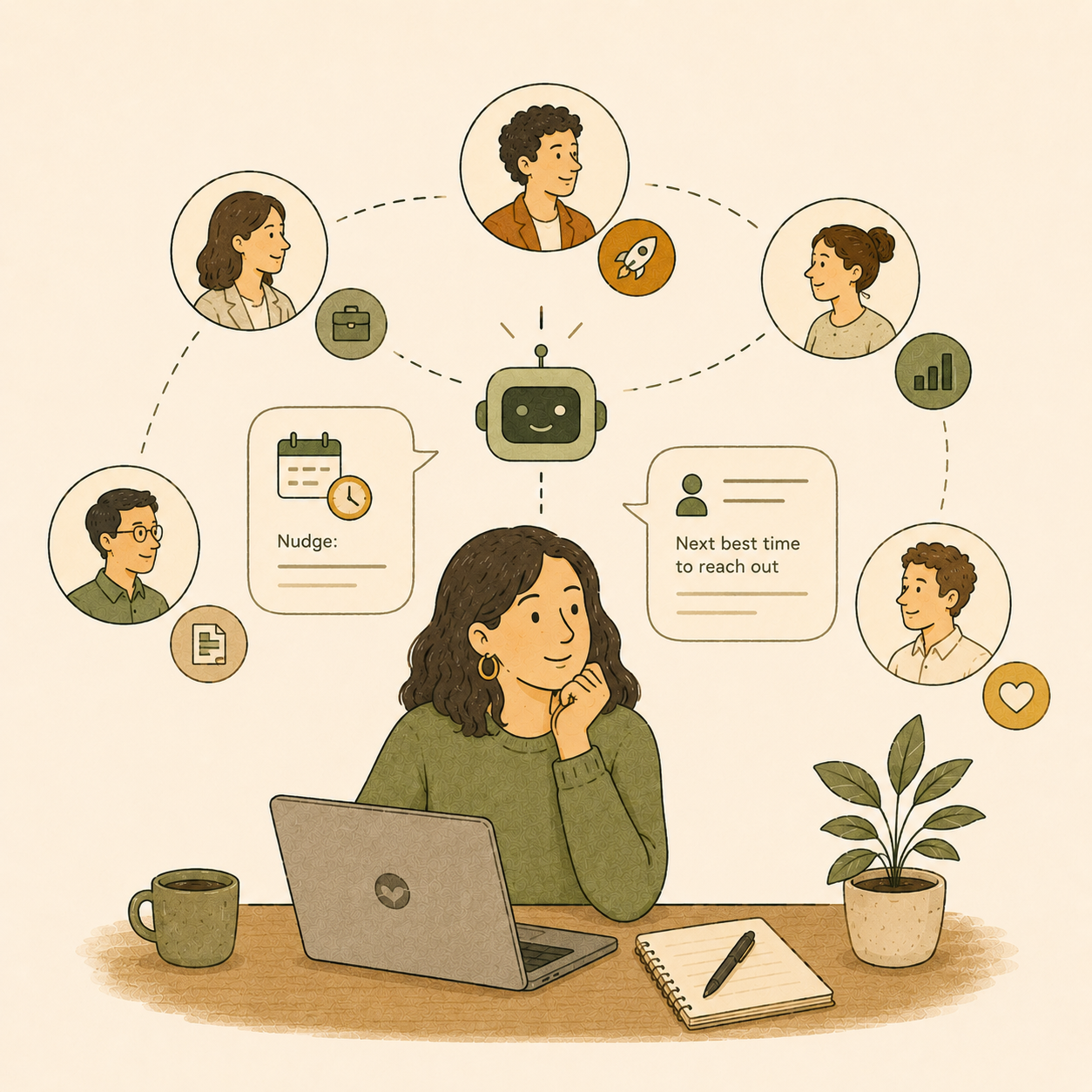
You meet someone at a conference, have a sharp ten-minute conversation, and leave with a genuine sense that this person matters. Three weeks later, their name is buried in your inbox, and you have no idea what to say. That is the central frustration of professional networking in the AI era, and it is one that AI networking tools are uniquely positioned to solve.
When you use AI to manage the timing, patterns, and prompts behind your outreach, the relationships that would have faded become the ones that actually move your career forward.
This article breaks down exactly how to use AI networking to strengthen real relationships rather than automate them into oblivion.
Most professionals lose their best connections because of the gap between good intentions and consistent action. The cost stays invisible until an opportunity passes and you realize the person who could have helped you has not heard from you in two years.
A connection goes cold gradually, not all at once. You tell yourself you will reach out after the busy season, after the product launch, after things settle down. Things never settle down. That means the relationship does not degrade from a single neglect but from dozens of small moments where you chose not to act.
The professional cost is real. That person who interviewed you for a role you did not get, the founder you met at a dinner who pivoted into your exact target market, the investor who said "keep me posted," each of these people had potential value that evaporated the moment contact dropped below a recognizable threshold.
Robin Dunbar's research on cognitive limits suggests you can maintain roughly 150 meaningful relationships at once. In practice, most professionals actively maintain far fewer. The connections that drift past that threshold do not disappear; they become dormant, and dormant connections require a specific kind of effort to reactivate.
The problem is not that you do not care. The problem is that caring does not produce a calendar entry. Good intentions exist in your head. Follow-up has to happen in someone's inbox, and those two things live in completely different systems.
Without a structured process, you default to recency and lose sight of what social capital is in a long-term professional context and how it shapes your future. You reach out to the people you have spoken to most recently, which means your oldest and often most valuable connections get the least attention. That is a bias baked into how human memory works, not a character flaw.
AI changes this dynamic by removing the burden of remembering. When a system tracks when you last spoke to someone, flags a contact you have not touched in 90 days, or surfaces a name when a relevant opportunity appears, you stop relying on memory and start acting on information.
AI is most useful in networking when it handles the cognitive load of tracking, so the human connection is preserved rather than replaced. The difference between a helpful tool and an annoying one comes down to whether it prompts better behavior or tries to substitute for it.
Your network generates more signal than you can consciously process. A contact mentions they are hiring. Another shares a post about a frustration that matches a solution you know about. A third has not responded to your last three messages, which might mean the timing is wrong or the relationship needs a different kind of touch. Individually, each signal is easy to miss. Across dozens of contacts, the pattern is invisible without help.
AI excels at this kind of pattern recognition. It can surface the fact that you have five contacts in the same industry vertical who have all recently posted about the same challenge. That context lets you reach out thoughtfully, with something genuinely useful to say.
The goal is to build relationship intelligence by using information that makes a human message feel timely and relevant rather than random.
More outreach is not the answer. The problem most professionals have is not that they send too few messages; it is that the messages they send feel generic because they lacked the right trigger. AI networking tools are most valuable when they tell you when to reach out, not just that you should.
A contact starting a new role is a natural opening. Another is a contact whose company just announced a funding round. A five-month silence after a strong conversation signals that the connection is at risk of going dormant. These are the moments where a short, thoughtful message lands well, not because you sent more but because you sent at the right time.
Think of AI here as a timing coach. It does not write the message for you, but it tells you that now is the moment when the message will actually mean something.
AI can surface the right moment to reach out, but it cannot read the emotional weight of a situation or decide how much honesty a message needs. The moments that matter most in a relationship are almost always the ones where human judgment is irreplaceable.
A contact who just went through a layoff needs a different message than one who just got promoted. A relationship you have not nurtured in three years needs a different approach than one you spoke to last month. AI can flag both situations, but weighing them is still your job.
The risk of leaning too heavily on automation is that you send the right message at the wrong emotional register. A thoughtful handwritten note beats a perfectly timed automated check-in every time. People feel the difference between a message that was sent and a message that was considered.
When the stakes are personal, such as a job loss, a health challenge, or a significant life transition, put the AI down and write the message yourself. That is exactly the moment when your voice matters most.
Personalization fails when it is cosmetic. Dropping someone's first name into a template or referencing their latest LinkedIn post does not make a message personal; it makes it slightly less impersonal, and most people can tell the difference.
Real personalization connects something specific about the other person to something specific about you. "I remembered you mentioned struggling with X, and I just ran into the same thing" is personal. "I saw your post and wanted to reconnect" is not.
Use AI to surface what you know about someone: previous conversations, shared interests, career milestones, but write the message with your own voice. AI can provide the raw material, but you must still shape it into something that sounds like you.
Your weak ties, the people you know loosely but have not spoken to recently, consistently produce more new opportunities than your inner circle. That is a counterintuitive finding that has been replicated across decades of social science research.
Mark Granovetter's original 1973 research on weak ties showed that people were more likely to find jobs through acquaintances than through close friends. The reason is structural. Your close friends mostly know the same people you do. Your weak ties connect you to entirely different parts of the social and professional world, which means they carry information your close circle does not have.
That insight holds up in the AI era. A Stanford study that examined millions of LinkedIn connections found that weak ties led to significantly more job mobility in high-tech and digital industries than strong ties did. In other words, the person you met once at a panel discussion is more likely to hand you an opportunity you have never heard of than the colleague you text every day.
The practical implication is that protecting your weak ties is not optional; it ensures your social capital future remains robust. It is one of the highest-return investments you can make in your career.
You do not need a major reason to reconnect. In fact, big asks after long silences are exactly what makes reconnection feel transactional. Small signals work best here: a congratulations on a new role, a reaction to a post, a short note saying you thought of them when you came across something relevant. These reactivate relationships without pressure.
AI networking tools are particularly good at identifying which dormant connections are worth prioritizing. If a contact's professional situation has shifted in a way that aligns with something you are doing or thinking about, that is a natural opening, not a cold outreach. This is the kind of work a tool like Goodword is built for: it watches for the shift in a dormant contact's situation and surfaces the opening, so reconnecting feels timely instead of random.
The message does not need to be long. Two sentences that reference something real about the person and require no response from them are almost always better than a paragraph that ends with "would love to catch up soon." Keep it light, keep it specific, and let the reconnection breathe.
A weekly networking routine does not need to take more than 20 minutes, but it does need a clear process. Building a networking future that works requires consistency over intensity. Specificity is what separates a routine that happens from one that stays on the to-do list forever.
Start each week by reviewing three categories:
Prioritize cooling contacts first. These are the relationships most likely to go cold if you wait another week. Dormant contacts with a clear opening signal are second. Warm contacts can wait; they already know you are present.
Your AI networking tool should surface this list automatically. Identifying these opportunities is one of the 4 networking moves to master in the age of AI to ensure your outreach remains effective. Your job is to pick two or three people from each category and decide who gets a message this week.
The hardest part of reaching out is the first sentence. Here are three starters that work because they reference something real and make no immediate ask:
Each of these opens a door without pushing through it. They give the other person something to respond to if they want to, and they do not feel like a setup for an ask.
Write the messages yourself using these as starting points. Do not copy and paste from an AI-generated template. The goal is to sound like you, because you are the relationship, not the tool.
The most common AI networking mistakes are relational, which explains why most networking advice no longer works. Using AI to scale outreach without adding genuine thought erodes your network. When managing relationships, transparency and intent are the only things that prevent your outreach from feeling like spam.
"Just wanted to check in and see how things are going" is the networking equivalent of a form letter. It signals that you have nothing specific to say, so the reader has no reason to respond. Sending this kind of message at scale, even with the right name swapped in, erodes trust faster than silence does.
Templates are useful for structure, not for substance. If your AI tool generates a message and you send it without changing a word, the recipient often feels that. The specific details that make a message feel personal are the ones no tool can generate for you, because they live in your memory of the relationship.
Reserve templates for logistics. Use your own observations for anything that is meant to maintain or reactivate a real connection.
Efficiency is not the goal of a networking practice; deep connection is. AI makes the confusion worse because it is very good at making outreach feel productive without feeling human.
Sending 30 messages in a week is not relationship building. Sending five messages, each containing something true and relevant, is. The test is not how many contacts you touched but whether any of those people felt genuinely seen.
The most durable professional networks are not built by the most prolific outreachers. They are built by people who made others feel that their time and attention mattered. Volume has nothing to do with it. What makes a network durable is the ability to make others feel that their time and attention mattered, and no tool can supply that.
AI can surface what to say, but only you can supply the reason to say it. The only standard that matters is whether the message genuinely serves the person receiving it, and only you can answer that.
AI is shifting networking from a memory problem to a systems problem. The contacts you lose are rarely lost because you stopped caring; they fade because there was no structure to keep them alive. AI changes that by tracking when you last spoke to someone, surfacing the right moment to reach out, and flagging relationships that are cooling before they go dormant. The technology does not replace the relationship. It removes the excuse for neglecting it.
More, not less. As AI makes surface-level outreach cheaper and easier, the signal value of genuine connection increases. Anyone can send a hundred messages. Fewer people can make someone feel genuinely seen. The professionals who build real relationships will stand out precisely because most outreach will feel automated. The bar for what counts as meaningful contact is rising, not falling.
It can be, if used badly. The distinction is whether the tool is replacing your judgment or supporting it. AI that fires off templated messages to hundreds of contacts without your review is spam infrastructure. AI that surfaces the right moment to reach out, reminds you what someone cares about, and then lets you write the message yourself is something genuinely useful. The technology is neutral; the intent behind it is not.
Technically yes. Practically, you should not let it. AI can provide useful raw material by surfacing past conversations, career milestones, and shared interests, but a message that goes out in your name needs to sound like you. The specific details that make outreach feel personal live in your memory of the relationship, not in a database. Use AI to prepare; write the message yourself.
Robin Dunbar's research suggests roughly 150 is the cognitive ceiling for meaningful relationships, but most professionals actively maintain far fewer. A more useful frame: sort your network into warm (touched in the last 30 days), cooling (60 to 90 days), and dormant (six months or more). Focus your weekly effort on the cooling tier first. Those are the relationships most likely to go cold if you wait another week.
Your close contacts mostly know the same people and opportunities you do. Weak ties are the people you know loosely but have not spoken to recently. They move in different professional circles, which means they carry information your inner circle does not have. Research consistently shows this effect is strongest in digital and high-growth industries. The practical implication is that reactivating a dormant connection is often more valuable than deepening an already strong one.
Start with a 20-minute review of your network. Identify two or three people in the cooling tier, contacts you have not spoken to in 60 to 90 days, and write each of them a short message that references something specific and makes no immediate ask. Do not use a template. Let the AI surface the context; let yourself supply the voice. That combination is what makes the difference between outreach that lands and outreach that gets ignored.
Any message that needs to land with emotional weight. A job loss, a health challenge, a major life transition, a genuine congratulations: these are the moments when your voice matters most and a templated response does active damage. Also: any reconnection after a long silence. The first message back into a dormant relationship should always be written by you, because the recipient will immediately feel whether it was considered or just generated.
AI networking is not about replacing the human element; it is about ensuring your most valuable connections do not slip through the cracks.
By using technology to manage the timing and logistics, you free yourself to focus on the authentic interactions that define a successful career. The goal is to move from reactive follow-ups to intentional relationship building.
If you are ready to stop losing track of your best ties, see how Goodword surfaces the connections worth reaching out to and the right moment to do it.

.svg)





.png)