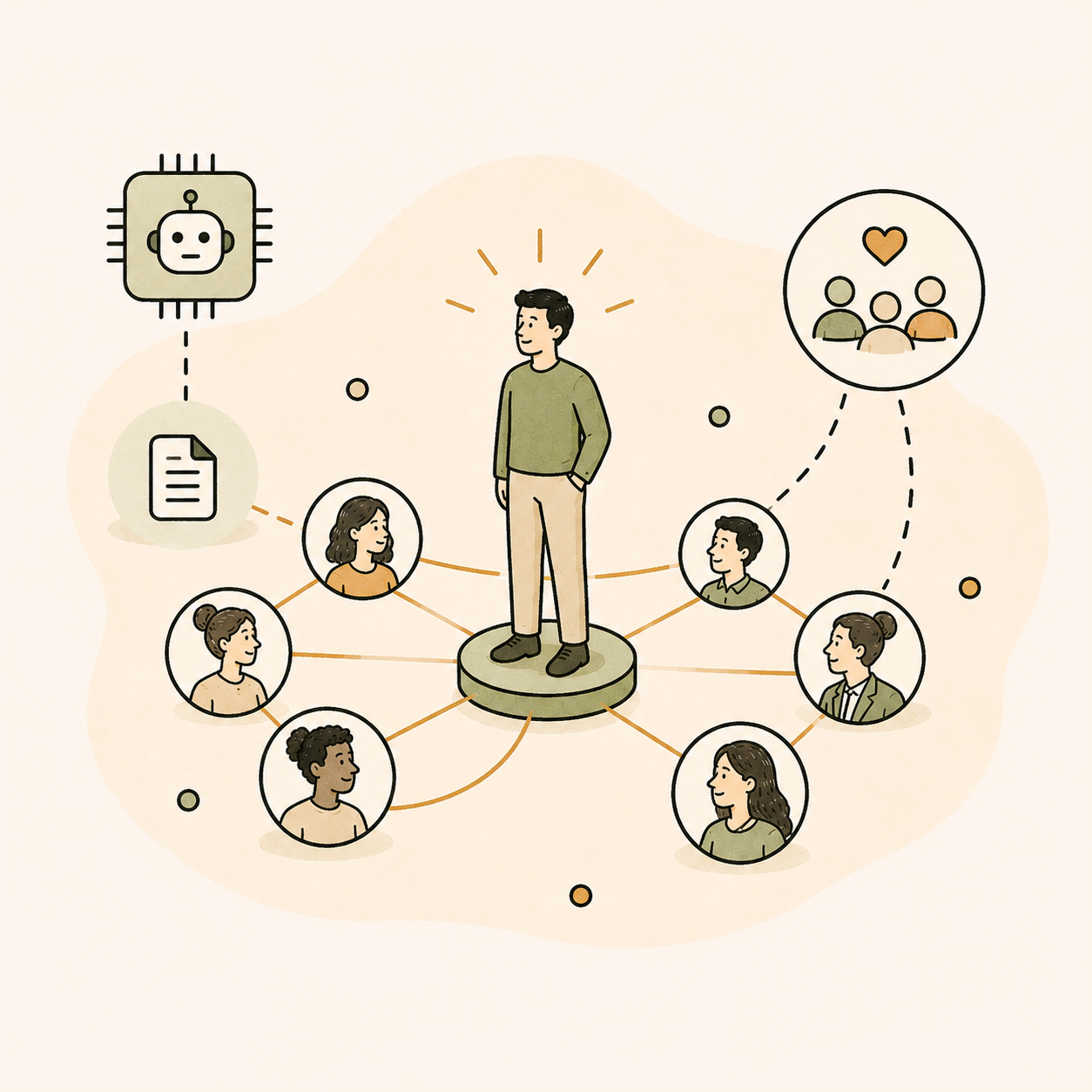
You spent six months learning a new tool, added it to your resume, and then watched a competitor ship the same capability inside ChatGPT three weeks later. That frustration is not a personal failure. It is the new normal, and it is exactly why understanding why relationships will outperform skills in the AI era matters more right now than any course you could take.
When your technical edge can be replicated overnight, the one thing that cannot be copied is who trusts you, who thinks of you first, and who picks up the phone when you call. That shift changes how careers get built, how deals get done, and how opportunities actually move between people.
Goodword understands how professional relationships actually compound over time, so this article walks you through the research, the mechanics, and the daily habits behind relationship-driven career growth. Read through to the end, and you will leave with a clear picture of what to do differently starting this week.
A skill that took you a year to learn can now be approximated by a well-prompted AI model in days, and that compression is accelerating. The advantage you build through credentials and certifications shrinks faster than it used to, which means the moat you build through relationships is becoming the only durable one.
Two years ago, knowing how to write Python scripts or build a financial model gave you a clear edge over peers who did not. Today, those same peers can produce working code and clean spreadsheets with AI assistance and almost no training. The skill gap that once took years to close now closes in an afternoon.
As the landscape of AI careers shifts, this is not a reason to stop learning. It is a reason to prioritize human connection in the age of AI as your primary differentiator. The people who moved fastest in their careers over the past decade did not just know more. They knew the right people, and those people brought them into rooms that credentials alone never would have opened.
Think about the last role you heard about before it was posted publicly. That information traveled through a relationship, not a job board. The same pattern shows up everywhere founders operate:
A new AI tool reaches millions of users within weeks of launch. Trust between two professionals takes months or years to build and cannot be downloaded. That asymmetry is the core argument for investing in relationships right now. Considering the future of work, it is vital to build trust before the next wave of automation arrives.
When everyone in your industry has access to the same tools, the person who wins the project, the partnership, or the promotion is usually the one the decision-maker already trusts. Capability is table stakes, while the importance of networking proves that credibility is the true differentiator. Credibility lives inside your relationships, not your resume.
Unlike a certification that depreciates, a strong relationship tends to grow more valuable the longer it exists. The social capital you build with a mentor, a peer, or even a former colleague does not expire; it compounds in the background until the moment it matters.
In a world where information is free and abundant, access is the scarce resource. Knowing that a company is about to open a senior role is only useful if someone inside that company thinks of you before the job posts. That kind of access does not come from being skilled. It comes from being known, trusted, and genuinely remembered.
For a founder, this plays out constantly. Two startups raise from the same fund with similar metrics. One gets a term sheet in two weeks because a mutual contact made a warm introduction and vouched for the founder's judgment. The other spends three months cold emailing associates.
It is the same product, with the same traction, but with a different outcome because access, not merit alone, determined the timeline.
Understanding what social capital is reveals how value is created through relationships, not just credentials. Researchers who study professional networks consistently find that people with broader, more diverse networks learn faster, advance further, and recover from setbacks more quickly than people with equivalent skills but narrower connections.
Your relationships are, in practice, a live feed of opportunities that no algorithm can replicate.
Career leverage is the ability to move faster, further, and with less friction than your resume alone would allow. A warm introduction from a mutual contact collapses months of cold outreach into a single conversation. A former manager who vouches for you in a hiring discussion shifts the entire weight of the decision in your favor.
This leverage is not built in moments of need. It is built through consistent, generous investment over time. The professional who reaches out only when they need something is recognizable and forgettable. The one who shows up consistently, shares useful information, and makes introductions without being asked is the one whose name gets mentioned in rooms they never entered.
Decades of research on how careers actually advance point to the same conclusion: your network structure matters as much as your ability. Two specific mechanisms explain most of the opportunity that flows through professional life.
Sociologist Mark Granovetter's research showed that most career-changing opportunities come not from close friends but from acquaintances: people you know well enough to trust but who move in different circles. These weak ties carry information you do not already have, because they are connected to networks you are not.
Your close colleagues know what you know. They see the same job postings, hear the same industry gossip, and move in the same orbit. Your weak ties see the world differently, which means they bring you news, referrals, and opportunities that never would have reached you otherwise. Maintaining those looser connections is how you keep your human connections going in this day and age.
AI can screen a resume, flag a candidate, and summarize a background check in seconds. But the decision to hire someone for a senior role, bring in a new vendor, or promote a team member into leadership still rests on human judgment and trust.
When the stakes are high, decision-makers default to people they know or to people vouched for by those they know. That pattern has not changed in the AI era. In the context of AI careers, personal trust has become the most efficient filter available because the volume of talent and information has grown so large.
The abstract case for relationships is easy to accept. The concrete mechanics of how they translate into real career outcomes are what most people overlook. Two patterns show up again and again in how strong networks create tangible professional wins.
A referral is not just a warm introduction. It is a transfer of credibility from one person to another, reinforcing the networking importance for any professional. When someone who is trusted vouches for you, they are lending you a portion of the trust they have built with the recipient. That borrowed credibility gets you in the door faster, heard more seriously, and evaluated more generously than a cold approach ever could.
This is why the quality of your relationships matters more than the quantity of your connections. One genuine endorsement from someone with deep credibility in a room will outperform fifty LinkedIn connections you have never spoken to.
This is also why referred hires consistently outperform sourced ones. When a trusted former colleague tells a founder, "This person is the best engineer I've worked with," that recommendation carries weight no resume can match because it's a transfer of credibility, not information. They're trusting someone whose judgment they've already verified.
Teams that have worked together before or share mutual contacts communicate with less friction and fewer misunderstandings. Shared context, built through relationship history, accelerates decision-making and reduces the time spent re-explaining priorities or negotiating roles.
When you already know how a colleague thinks, what they care about, and where they are likely to push back, you collaborate more efficiently. That efficiency compounds in cross-functional projects, client relationships, and any situation where speed and alignment matter. Strong networks do not just create opportunities. They make the work itself faster and better.
Founders often assume distribution is a marketing problem when it actually is a relationship problem in disguise. A founder mentions in passing to a former teammate that they're struggling to get into a particular market. That teammate happens to know the head of partnerships at a company already serving that market, and makes the connection unprompted.
There's no need for campaign, cold outreach, or paid acquisition. Just someone who remembered what the founder was working on and thought of them at the right moment.
This reactive approach is why most networking advice doesn't work anymore in a fast-moving market. The highest-return approach is a consistent, low-pressure investment that keeps relationships warm without requiring a major time commitment.
Relationship maintenance does not have to be complicated. A practical system that top networkers use looks like this:
These steps take under 30 minutes a week. Over the course of a year, it keeps dozens of relationships warm and positions you as someone who gives before they ask.
The difference between networking that works and networking that feels awkward is intent. Transactional outreach is easy to detect and easy to ignore. Generous outreach lands differently because the recipient can feel that you are not asking for anything.
Generous outreach sounds like this: "I read something this week that made me think of your situation at work. Thought it might be useful." Or: "I know you mentioned you were hiring for that role. I have someone in mind who might be worth a conversation." Or simply: "It has been a while. How are things going with the new team?"
None of these require a favor in return. All of them remind the other person that you are thinking about their interests, not just your own. That impression, repeated over time, is exactly what makes someone think of you first when an opportunity crosses their desk.
The professionals who will advance fastest over the next five years will not be the ones who learned the most tools. They will be the ones who use those tools to do more of what only humans can do: build trust, exercise judgment, and maintain compounding relationships.
In the future of work, as AI handles more of the analytical and operational work, the decisions that remain in human hands tend to be the ones with the most ambiguity, the highest stakes, or the deepest ethical complexity. Those decisions require judgment, and judgment is not a technical skill. It is a capacity developed through experience, relationships, and exposure to how real situations actually unfold.
The professionals who cultivate genuine judgment by staying curious, staying connected, and staying accountable to real feedback from real people will be the ones trusted with the decisions that matter. That trust is not earned through credentials. It is earned through a track record visible to people who know you.
AI is genuinely useful in your professional life when it helps you be more present, more informed, and more responsive in your human relationships. It can help you draft a thoughtful follow-up, surface a relevant article to share, or remind you that a contact's company recently made news worth asking about.
What AI cannot do is replace the warmth of a genuine check-in, the credibility of a personal introduction, or the trust built over years of showing up for someone. This focus on high-value interactions is why we built Goodword, enabling you to invest in the relationships that define your professional life.
Not the ones that matter most. Technical skills are increasingly replicable by AI, but emotional intelligence, sound judgment, and the ability to build genuine trust are not. These capacities depend on lived experience, relational context, and the ability to read situations that do not fit a pattern. Professionals who invest in these areas will consistently outperform those who compete solely on technical ability.
Because AI has made surface-level communication faster and cheaper, it has raised the bar for what counts as a meaningful interaction. A generic message is easy to recognize and easy to ignore. Genuine, personalized outreach now stands out more than ever, which means the people who invest in real connection have a greater relative advantage than they did a decade ago. As automation increases, trust becomes scarcer and therefore more valuable.
Focus on the skills that require a human on both ends of the interaction: listening, earning trust, navigating complexity, and making judgment calls that cannot be reduced to a pattern. Practice listening more than you speak in professional conversations, ask questions that reflect genuine curiosity, and seek feedback from people who will tell you the truth. Influence grows from credibility, and credibility grows from being known as someone who listens, follows through, and puts others' interests ahead of their own.
Be transparent about what AI is doing and why, so your team does not fill the gap with fear or suspicion. Involve people in decisions about how AI tools get used rather than rolling out changes from the top down. Trust grows through inclusion and honest communication, not through mandates.
Most AI initiatives fail not because of technical problems but because of human ones: resistance from teams, misalignment between departments, or a lack of trust in the people driving the change. Building strong stakeholder relationships before a project launches means you have the credibility and goodwill needed to navigate friction when it inevitably appears.
Roles where the relationship is the work. Senior leadership, client-facing advisory, therapy, negotiation, and anything that requires building trust over time are the most durable career paths. In these roles, human connection is not a secondary feature of the job; it is the core deliverable, and that is something AI cannot replicate.
Make a habit of asking questions that reflect genuine curiosity about the other person's situation rather than moving conversations toward your own agenda. Seek feedback from people who will tell you the truth. Follow through consistently, even on small things, because reliability is the foundation of influence. The professionals who will stand out in an AI-saturated environment are not the ones with the most impressive tools; they are the ones other people actually want to hear from.
The clearest insight from everything above is this: in an environment where every technical skill is compressible, and every tool is replicable, the only career asset that grows more valuable over time is the trust others place in you. That trust is built through consistent, generous investment in relationships, long before you need them to produce anything.
When you start treating your network as something to maintain rather than something to mine, the quality of your professional life shifts. Opportunities surface earlier, doors open with less friction, and the work itself becomes better because you are doing it alongside people who know and trust you.
If you want a practical way to start building that kind of network, Goodword was designed exactly for this. Start your free trial today and begin investing in the relationships that will define your next chapter.

.svg)





.png)