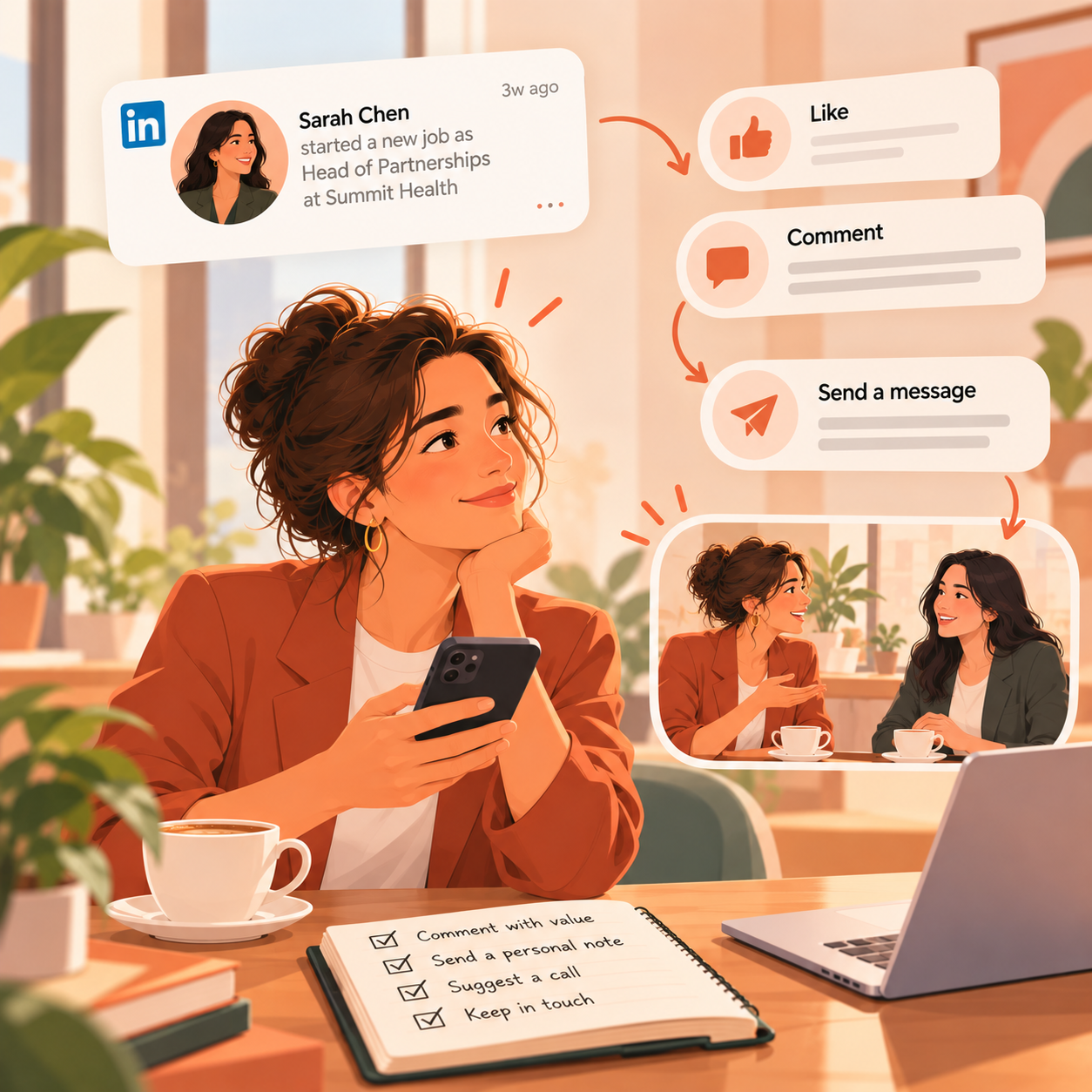
Your old manager started a new job three weeks ago. LinkedIn told you about it, you tapped the thumbs-up between two meetings, and that was the entire exchange. Forty other people did the same thing, and she can't tell any of you apart. Most advice on how to network on LinkedIn treats the site as a place to meet strangers. That advice misses what LinkedIn is unusually good at: telling you, in real time, when someone you already know has a reason to hear from you.
Networking on LinkedIn works best as relationship maintenance: using the platform's signals to notice the right moment, adding something real, and moving the conversation somewhere more human.
Collecting connections is easy and almost worthless. Keeping a few hundred of them warm enough that a message from you feels natural is hard, and it's where nearly all the value lives.
Look at your connection list and you'll find a strange mix. A handful of close colleagues. A long middle of people you worked near, met at a conference, or spoke to once on a call. A tail of people you can't place at all.
That long middle is the part worth your attention. In 2022, researchers from MIT, Stanford, Harvard and LinkedIn published a large field experiment on weak ties in Science. Over five years, from 2015 through 2019, LinkedIn varied its "People You May Know" suggestions for about 20 million users. As MIT News reported, moderately weak ties produced the most job mobility, with usefulness peaking at around 10 mutual connections. The effect was strongest in digital industries.
So the people most likely to matter are the ones you know a little and are letting drift. They're also the people LinkedIn keeps putting in front of you, in the feed and in your notifications. Most people undercount this group badly, which we explore in how much larger your network really is, and the case for weak ties as a career advantage goes deeper on the research.
The feed is designed to be scrolled. Treat it instead as a stream of small invitations, most of which you'll decline, and a few of which you should accept with real effort.
Some signals are worth acting on:
Other signals are mostly noise. Automated birthday prompts and work anniversaries invite the lowest-effort reaction possible, which is why they rarely build anything.
Timing does more work than frequency here. A single message sent the week someone takes on a new role can outlast a year of likes, a point we make at length in why timing matters more than networking volume.
Goodword brings your LinkedIn connections in beside your email and calendar, so a job change shows up next to the last real conversation you had with that person. Start your free trial.
A reaction button costs nothing, and the person on the receiving end knows it. A comment can be different, if you treat it as a small piece of work.
A good comment usually does one of a few things. It adds a specific experience that confirms or complicates the post. It disagrees with part of it, politely and with a reason. It asks a question that only someone who read past the first line would think to ask. Any of these tells the author that a particular person was paying attention.
Most people hold back from this. They worry a substantive comment will seem like too much, or that disagreeing in public is awkward. Look at it from the author's side, though. Someone who writes a post has usually spent an hour or more on it, and then watches a row of thumbs come in. A comment that engages with the third paragraph, or pushes back on one claim, is the first sign that a person actually read it. Authors reply to those comments, and they remember who wrote them.
People still default to "Great post!" because it feels safe, and safe is forgettable.
You don't need a content strategy to network well on LinkedIn. You do benefit from giving people a reason to think of you.
One honest post about a problem you're working on does more for your relationships than a weekly schedule of generic advice. It tells your network what you care about right now, which is the information people need before they can send an opportunity your way. The connections who reply to that kind of post are often the ones you should follow up with first.
Write about what you're actually doing. Skip the engagement bait. The audience that matters is the few dozen people who already know you and are trying to remember what you're up to.
LinkedIn is a good doorway and a poor room. Comment threads and short messages are fine for the first exchange or two, but relationships deepen through conversations with more bandwidth: a call, a coffee if you're in the same city, an email thread where people can say more.
A useful rule is to suggest a change of channel once there's something real to talk about. If you've traded two or three messages about a shared problem, a twenty-minute call is a natural next step. If someone mentions they'll be in your city, that's the moment to offer to meet.
The move doesn't need to be formal. You're shifting from public signal to private conversation, and most people welcome that once a little goodwill exists. Using more than one channel also makes the tie sturdier. A relationship that lives only in LinkedIn comments disappears the moment either of you stops posting.
The people who get the most from LinkedIn tend to use it less often and more deliberately. A short block once a week is enough.
Look through recent notifications and activity for people you would genuinely want to talk to. Pick a small number. For each one, decide whether the right move is a comment, a direct note, or a suggestion to catch up properly, and then do it while the reason is fresh. Write down why you reached out so the next conversation has context.
If you'd like to work with your whole LinkedIn network at once, our guide to getting your LinkedIn network into ChatGPT covers the export and the questions worth asking of it. And if you'd rather have that context assembled for you, Goodword on desktop pulls LinkedIn, Gmail and your calendar into a single view of each person.
A year of deliberate LinkedIn networking rarely looks dramatic. Your connection count might barely move. What changes is how many of those connections would recognize your name in their inbox and be glad to see it.
That recognition is what makes everything else possible: the referral, the introduction, the early heads-up about a role. It comes from paying attention at the right moments, consistently, to people you already know.
When the feed tells you someone just changed jobs, Goodword can remind you what you two last talked about. Try Goodword free.
On its own, very little. A like registers as a notification and is forgotten almost immediately. It can be a reasonable starting signal, but a thoughtful comment or a short direct note does far more to keep a relationship warm.
There's no magic cadence. Posting when you have something real to share, such as a project, a lesson or an open question, works better than posting on a schedule. The aim is to keep your network current on what you care about, and that can be once a month.
Accepting everyone dilutes your feed and makes it harder to notice signals from people you actually know. A reasonable test is whether you'd recognize the person's name in a message a year from now. If the answer is no and there's no note explaining the request, it's fine to leave it.
It's most useful then. Relationships built while you need nothing are the ones that hold up when you do need something. Staying in touch during a stable stretch also means your first message during a search won't come out of nowhere.
Once you've exchanged a few messages about something specific and there's a clear reason to talk further. Suggest a short call or coffee and keep the ask light. If the other person prefers to stay in messages, follow their lead and try again later.