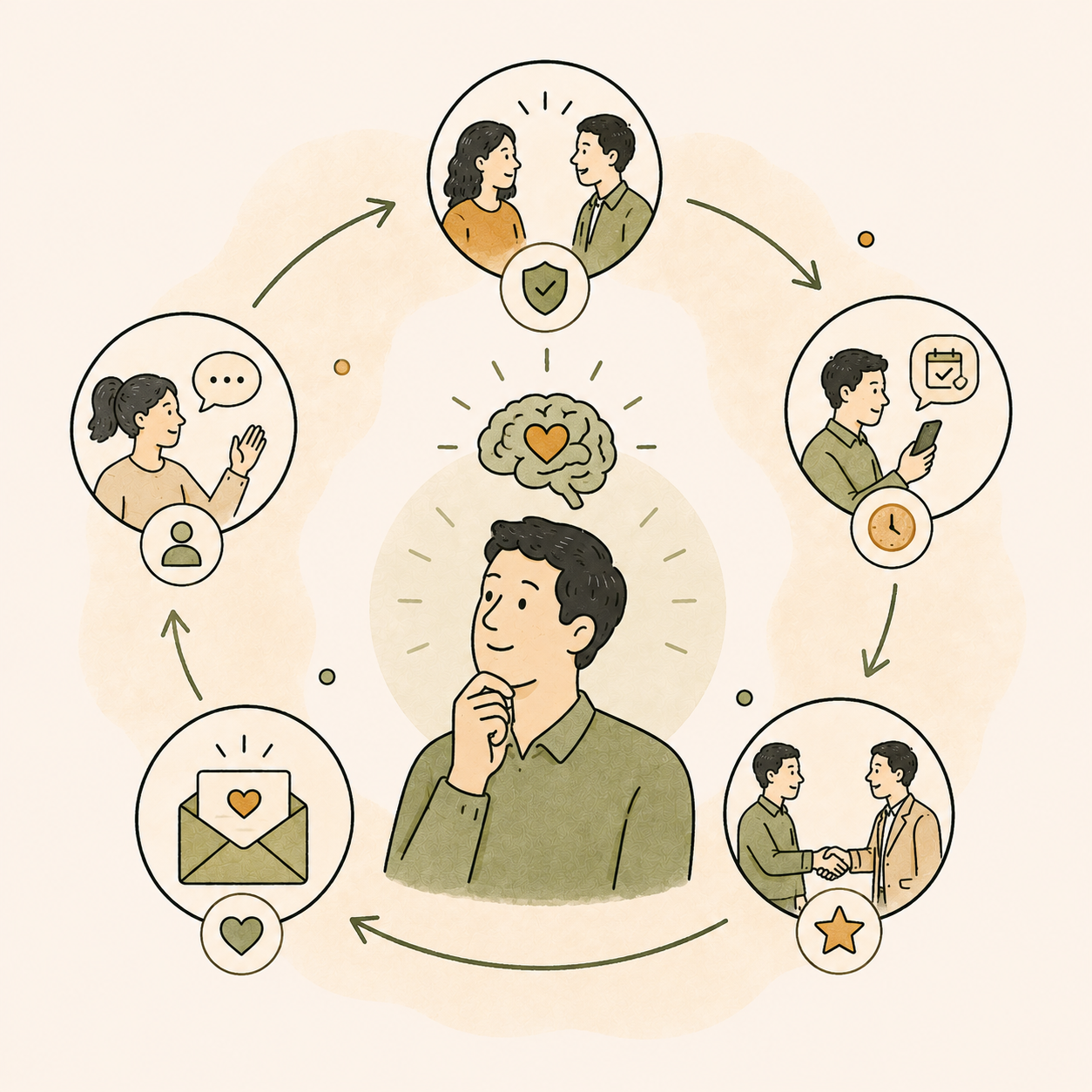
You have had the experience of meeting someone at a conference, exchanging cards, following up once, and then watching the connection disappear. No falling out, no drama, just drift. And somewhere in the back of your mind, you wonder what the people with deep, durable professional networks are actually doing differently.
The psychology behind strong professional relationships shows that lasting bonds are not built on personality or luck, but on specific, repeatable behaviors that your brain and the brains of the people around you respond to in predictable ways. When you understand what drives trust, reciprocity, and belonging at a biological level, you stop leaving your most important relationships to chance.
This article breaks down the science in plain language, from why trust forms faster than most people realize to how to repair a connection that has gone cold. Let Goodword's input in networking psychology and practical network-building give you a clear framework you can act on today.
Your brain makes trust decisions within seconds, not months, which means the earliest moments of any professional relationship carry more weight than most people give them credit for. This core tenet of networking psychology explains why consistency over time converts that early impression into something real and durable.
Before you say a single word in a meeting, the other person's brain is already processing signals. Eye contact, posture, tone of voice, and whether your facial expression matches what you are saying all register below conscious awareness.
Neuroscience research consistently shows that positive social connection and feeling supported suppress cortisol, the body's primary stress hormone, while social threat and exclusion trigger the same stress response as physical danger.
A placebo-controlled study published in Biological Psychiatry found that social support suppressed cortisol levels in response to stress, and that the combination of social support and oxytocin produced the lowest cortisol concentrations alongside increased calmness and decreased anxiety.
The practical implication for human interaction is direct: feeling genuinely seen lowers a person's defenses, while feeling dismissed or ignored activates the same neurochemical threat response that shuts down openness and trust.
That means the small stuff is not small. Showing up on time signals that you value someone's schedule. Remembering a detail from the last conversation proves that they are worth your attention. These micro-behaviors communicate safety before trust has had any time to develop through shared experience.
Charisma opens a door. Consistency keeps it open. Research on trust formation consistently shows that people do not stay connected to people who are exciting but unpredictable; they stay connected to people who behave the same way whether the stakes are high or low.
In practice, this means your most trust-building move is often the most boring one: doing what you said you would do, on time, without being asked twice. A colleague who always follows through on small commitments earns more trust than one who makes grand gestures and then disappears. Your brain tracks patterns, and so does everyone else's.
Reciprocity is one of the most reliably documented forces in social psychology, and it works differently in professional relationships than most people expect. The goal is not to create a ledger; it is to create a rhythm.
When you give something of value, whether it is a referral, a piece of information, or a candid observation, the receiving person feels a natural pull to give back. This is not manipulation; it is how human social bonds have worked for thousands of years. Author Adam Grant's research on givers and takers found that people who give without tracking returns consistently build stronger, more durable networks than those who give transactionally.
The trap is turning generosity into a transaction. If you share a contact and then immediately ask for a favor, you collapse the psychological distance between giving and expecting, which feels transactional and erodes trust. Give first, then let time pass. The return usually comes, often from a different direction than you expected.
Reciprocity has a short half-life if it is not reinforced. When someone does something for you, and you respond within 48 hours, whether with a thank you, a relevant article, or a specific next step, the exchange stays warm. When you wait two weeks, the emotional moment has passed, and your response lands flat.
Think of it as momentum. A quick reply says, "I was thinking about you." A reply that comes late says "I got around to you." The gap between those two messages is the gap between a relationship that grows and one that stalls.
Your closest colleagues share most of your information and move in most of the same circles, which is exactly why the people at the edges of your network are often the ones who change your trajectory. The science here is specific and worth knowing.
In the 1970s, sociologist Mark Granovetter studied how people found jobs and discovered something counterintuitive: most people landed roles through acquaintances, not close friends. He called this "the strength of weak ties." The reason is structural. Your tight inner circle already knows what you know. A former colleague you spoke to once at a conference moves in completely different circles and hears about opportunities you would never encounter on your own.
A 2022 study published in Science, using randomized experiments across 20 million LinkedIn users, validated Granovetter's original finding at massive scale, confirming that new job opportunities came disproportionately through weak ties rather than close connections.
That one person you vaguely know at a company you admire is not peripheral to your network; they often embody what makes someone a superconnector. They may be the most strategically valuable person in it.
The challenge with weak ties is that you cannot invest in them the way you invest in close relationships, and trying to do so feels forced. The better approach is low-effort, high-frequency presence. A comment on someone's post, a short message when you read something relevant to their work, or a reply to their newsletter all signal that you are paying attention without demanding anything in return.
The goal is to stay visible enough that when an opportunity arises that fits you, they think of you first. You are not trying to deepen every acquaintance. You are trying to stay warm with enough of the right people that your network consistently connects dots you cannot connect yourself.
People do not stay in professional relationships that feel unsafe or invisible, and they fight hard to protect the ones that feel the opposite. Two forces drive this more than any other: the need to feel psychologically safe, and the need to feel recognized.
Psychological safety is the belief that you can speak honestly, make mistakes, and raise difficult topics without being punished for it. When you create that feeling in a professional relationship, you are not just being kind; you are activating one of the most powerful retention mechanisms in human psychology.
Amy Edmondson's research at Harvard established psychological safety as a foundational driver of team performance, a finding later confirmed at scale by Google's Project Aristotle, which identified it as the single strongest predictor of team effectiveness across 180 teams.
At the relationship level, it works the same way. When someone feels safe with you, they open up, share real information, and actively look for ways to keep the connection alive. When they feel judged or unsafe, they pull back, even if they never say why.
Status matters to people in ways they rarely admit. Being seen, acknowledged, and credited for your contributions is not vanity; it is a core psychological need. When you genuinely recognize someone's work or expertise, you increase the likelihood they remember you, creating a strong emotional anchor in the relationship.
This does not require grand gestures. Naming someone's contribution in a meeting, forwarding their work to a relevant person, or simply saying "that was a smart call" in a one-on-one lands with more impact than most people realize. Recognition is cheap to give and expensive to withhold.
Social capital is the value created through your relationships, not your credentials. Building it is less about big networking events and more about real connections: small, consistent habits that simplify relationship building and keep connections warm between the moments that matter.
The relationships that survive years of distance and schedule changes are almost always the ones where someone maintained a low-effort, consistent presence. That does not mean monthly calls with everyone you know. It means having a system.
A few habits that work in practice:
These habits sound small because they are. But compounded over months, they are the difference between a network that feels alive and one that exists only on LinkedIn.
If you have a relationship that has gone silent, and you want to reactivate it without sounding like you need something, try this:
"Hey [name], I came across [specific article, project, or news item] and immediately thought of you because of [specific reason tied to their work or interest]. No ask here, just wanted to pass it along. Hope things are going well on your end."
That message works because it is specific, it references them rather than you, and it asks for nothing. It signals attention without creating obligation. Send three of those this week to people you have not spoken to in over six months and see what comes back.
Most professional relationships do not end with a fight. They end with slow, mutual neglect that neither person notices until the connection is already gone. Catching that drift early is a skill worth building.
Drift has early warning signs if you know what to look for:
None of these signals mean the relationship is over. They mean it needs attention. The mistake most people make is waiting until the connection feels completely cold before acting, at which point reactivation feels awkward for both sides.
The most common mistake in reconnecting is leading with a need. When the first message someone receives from you after a long silence is a request, they read it as "I only reach out when I want something," which is exactly the impression you want to avoid.
Repair starts with a genuine, no-ask touchpoint. Reference something specific to them, not something generic. Acknowledge the gap without over-explaining it: "It has been too long" is enough. Then let the conversation breathe before you bring any agenda to it. A relationship that drifted over six months will not recover in a single message, but it can absolutely recover with two or three consistent, low-pressure touches over a few weeks.
Strong professional relationships are built on specific, repeatable behaviors: consistency, reciprocity, and the kind of reliability that makes people feel safe depending on you. They are not the result of personality or luck. They are the result of how you show up for others over time, especially in the moments when it would be easier not to.
You build trust through small, consistent actions repeated over a long time. Following through on commitments, responding honestly under pressure, and treating people the same way regardless of who is watching; these are the behaviors that register as safe in someone's mind. Trust is not declared; it is recognized, gradually, through pattern.
Presence matters most, and presence does not require grand gestures. A short message at the right moment, a follow-up that references something specific, a check-in that asks nothing in return; these are the actions that keep a relationship alive between the bigger interactions. Goodword follows this principle: that the small, well-timed touch is what separates a relationship that compounds from one that fades.
Trust between colleagues builds through consistent, predictable behavior over repeated interactions. When you do what you say you will do, respond with honesty, and treat people the same way regardless of who is watching, your brain registers it as safe. Over time, that pattern creates a foundation strong enough to survive disagreement and distance.
Emotional intelligence allows you to read the emotional tone of a conversation accurately and adjust your response in real time. In practice, this means noticing when a colleague is stressed before they say so, or recognizing that a flat reaction in a meeting signals disagreement rather than agreement. People who do this well create fewer misunderstandings and resolve friction faster than those who do not.
Reciprocity creates the rhythm of a healthy professional relationship. When both people feel that the exchange of support, information, and effort is roughly balanced over time, the relationship feels worth investing in. Fairness does not mean keeping exact score; it means neither person feels consistently taken for granted.
Conflict addressed directly and respectfully actually deepens trust because it signals that the relationship can handle honesty. The key is to separate the problem from the person, stay specific about the behavior rather than the character, and listen long enough to understand the other person's perspective before responding. A resolved conflict often creates more loyalty than a smooth relationship that has never been tested.
When both people know what is expected of them and where their responsibilities begin and end, there is less room for resentment to build. Ambiguity about roles breeds assumptions, and assumptions breed disappointment. Clear boundaries are not walls; they are agreements that protect the relationship from the friction that unclear expectations always create.
When people work toward a goal they all believe in, the relationship is anchored in something larger than any one person's preferences. Shared purpose creates natural reasons to collaborate, which generates the small moments of mutual support that belonging depends on. Research consistently shows that belonging, not perks or pay, is the strongest predictor of whether someone stays engaged and loyal to a team.
Strong professional relationships are not the result of personality but of specific choices made consistently over time that signal to other people's brains that you are safe, reliable, and worth investing in. That is the core insight: your network is not a reflection of who you know; it is a reflection of how you show up for people.
When you act on that understanding, something shifts. You stop treating relationship building as a task and start treating it as a practice. By prioritizing human connection, you notice the drift before it becomes distance.
Goodword supports exactly this kind of relationship practice. If you want a structured way to stay present with the people who matter most to your work and your growth, start your free trial and see how much easier it becomes when you have the right system behind you.

.svg)





.png)