A former manager mentioned, almost in passing, that her team was struggling to fill a role you'd have been perfect for. That was in a text eight months ago. You meant to follow up on it, then the thread scrolled past, and the role got filled by someone already in her orbit. She didn't forget you. You just weren't there when it mattered.
That is what most professionals get wrong about their network. The names are saved. The connections exist. What is missing is the context behind each relationship and a sense of when to act on it.
Personal relationship management is a discipline, not a database: it's about showing up with the right context at the right moment, rather than tracking people the way a sales team tracks prospects.
This guide covers what personal relationship management looks like in daily practice, why timing and context are the two variables most people never control, and how a light system beats a heavy sales setup. Timing is the one thing your effort cannot fix after the fact.
Context is what turns a saved name into a relationship you can act on. Without it, you know how to reach someone but not why the conversation should continue.
Think about the last useful message you received. It probably referenced something specific: a project you mentioned, a city you moved to, a problem you were stuck on. That kind of message comes from someone who kept the thread and picked a sensible moment to pull it, not from luck.
A handful of details, kept for each person, is enough to make the next conversation easy to start.
Five lines of notes per person do more for your professional relationships than a thousand contacts with nothing but a phone number.
An address book answers one question: how do I reach this person? Personal relationship management answers a harder one: what should happen next, and when?
In a 2026 survey of 542 professionals, Goodword found that the main obstacle was rarely access to people, but remembering the context and choosing the right moment to reach out.
So where exactly do those moments get lost?
Two gaps quietly drain value from strong networks: you reach out too late, and you reach out with nothing to say. Both are fixable, and neither requires more socializing.
Most opportunities have a window. A new role gets filled. A budget closes. A referral goes to whoever came to mind first. Once that window shuts, the same message that would have landed in week one feels random in month five.
After a good first conversation, the useful window is days, not months. Set a follow-up reminder before you leave the parking lot, then a second one 60 to 90 days out.
Calendar sync helps here. When a follow-up sits in the same place as your meetings, it competes for real attention instead of living in a note you never reopen.
"Just checking in" is a message with no content. Compare it to: "Last time we spoke, you were hiring two engineers in Austin. Did that land?"
Reasons are everywhere once you look: a promotion, a company milestone, an article that matches their problem, a person they should meet. Email threads and LinkedIn updates are full of these signals. The trick is catching them while they still count.
Reminders only work if you trust them. Ten daily nudges about people you barely know will train you to swipe them away.
Keep prompts tied to something real: an open promise, an important date, or a contact you decided matters. Automated data entry and an AI assistant can carry the record-keeping so the prompt arrives with context already attached.
The next question is how often to show up without turning your week into admin work.
A workable rhythm takes about 15 minutes a week. You are not maintaining a whole network; you are maintaining a short list on purpose.
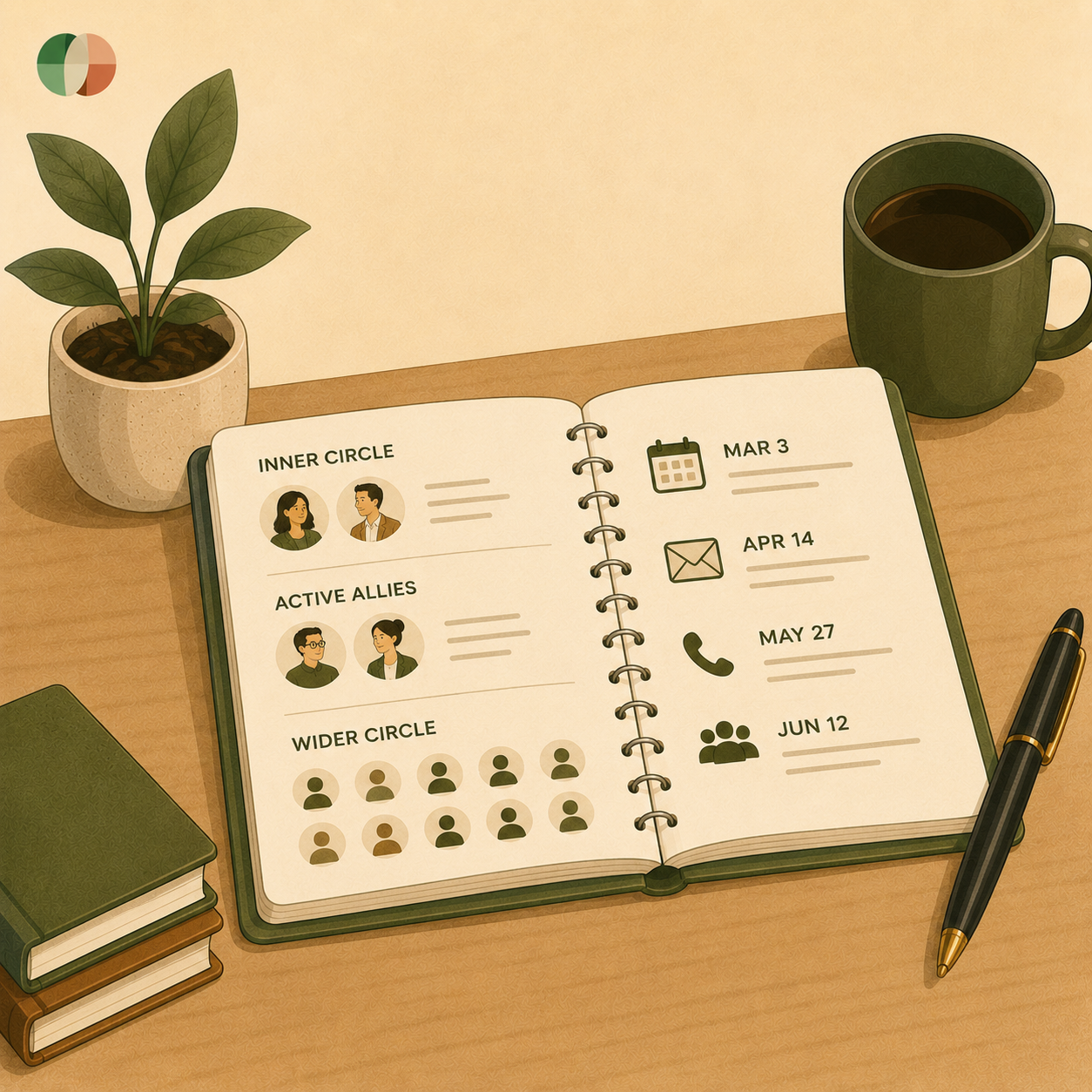
Sort your contacts into three loose circles. An inner circle of 15 to 25 people you speak with every four to six weeks. A middle circle of 50 to 100 people worth a touch twice a year. Everyone else stays searchable, not scheduled.
Cadence is a starting point, not a rule. If someone's world changes, you move; if nothing is happening, you wait.
Write your notes within an hour. After a day, you keep the vibe and lose the specifics that made the conversation worth having.
Card scanning, contact import, and a browser extension shorten the gap between meeting someone and having a usable record. Add a photo or a document if it helps you place them later.
Pick one time each week. Review the prompts, send two or three messages, close the loop on one promise, and stop.
In the same 2026 survey, the people who felt in control of their network were not the ones sending the most messages. They were the ones with a repeatable habit and a system holding the details.
Which raises a fair question: what kind of system should be doing that holding?
Sales software is built to move deals through stages. Personal relationship management is built to keep people warm when there is no deal at all. Those are different jobs, and using the wrong tool is why most attempts fail by week three.
A pipeline view asks what stage someone is in. Your network does not have stages. A friend from grad school, a former manager, and a potential client all matter, and none of them belong in a forecast.
This is exactly where a networking CRM and a plain sales CRM part ways, even though they're often sold as the same thing. Whether you call it a contact relationship management system or a personal CRM, the real test is the same: does it prompt you to act, or does it just store what you already knew?
If you actively maintain 30 or 40 relationships, a spreadsheet with names, last contact, and notes can hold up fine. It is free, portable, and simple.
Spreadsheets fail on one thing: they never tell you anything. They wait for you to open them, which usually happens right after you needed them.
A dedicated personal relationship management system earns its place when volume and timing outgrow memory. Signs you have crossed that line:
Your network is personal data about other people. Ask who can see it, whether you can export it, and what happens if you stop paying.
Then judge the tool by attention cost. If it needs 20 fields per contact and email campaigns you will never send, it will lose to your inbox by Friday.
The last step is putting all of this to work on the network you already have.
The connections you already have could be doing more for you if they were easier to act on: fewer decisions, better timing.
Not the most impressive 20, the 20 where a real conversation is still plausible and useful in both directions.
Write three lines each: how you know them, what they are working on, and one thing you could do for them. That single hour of work is the whole foundation of relationship management for the year ahead.
A personal CRM is software built around you rather than a sales team, holding notes, interaction history, and follow-up dates for people you care about. It helps by keeping context available so your next message continues a real conversation. The value is continuity, not volume.
Look for a personal relationship manager with smart reminders tied to real signals: open promises, important dates, and how long someone has been silent. Calendar sync matters too, since a prompt you never see does nothing.
Choose a small circle of 20 to 25 people and set a cadence for each one, then log a short note after every meaningful conversation. Spend 15 minutes a week reviewing who is overdue. Consistency on a short list beats sporadic effort across hundreds of names.
Prioritize fast note capture, interaction history, follow-up reminders, contact categorization, important dates, and clean data export. Skip pipelines, email marketing, and heavy custom fields you will never fill in. If setup takes more than an afternoon, you probably will not stick with it.
Yes, when it has context to work with. An AI assistant can scan your notes and history and suggest who actually knows the company, market, or role you are asking about. It narrows the list; you decide whether the ask is fair.
The best one for a beginner is whichever you will open weekly, which usually means light setup and a single clear daily view. Start with 20 contacts, one cadence, and one weekly review slot. If a free trial survives three weeks of your real schedule, it fits.
Goodword works as an AI copilot for the timing and context layer. It keeps the details straight, watches for the moments worth a message, and prompts you with a reason already attached. You still decide who to reach out to and what to say. That judgment is yours, and it should be.
That is the honest promise of personal relationship management: better moments, not more effort.
Your network already has what you need. Start your free trial and see who comes up first

.svg)





.png)