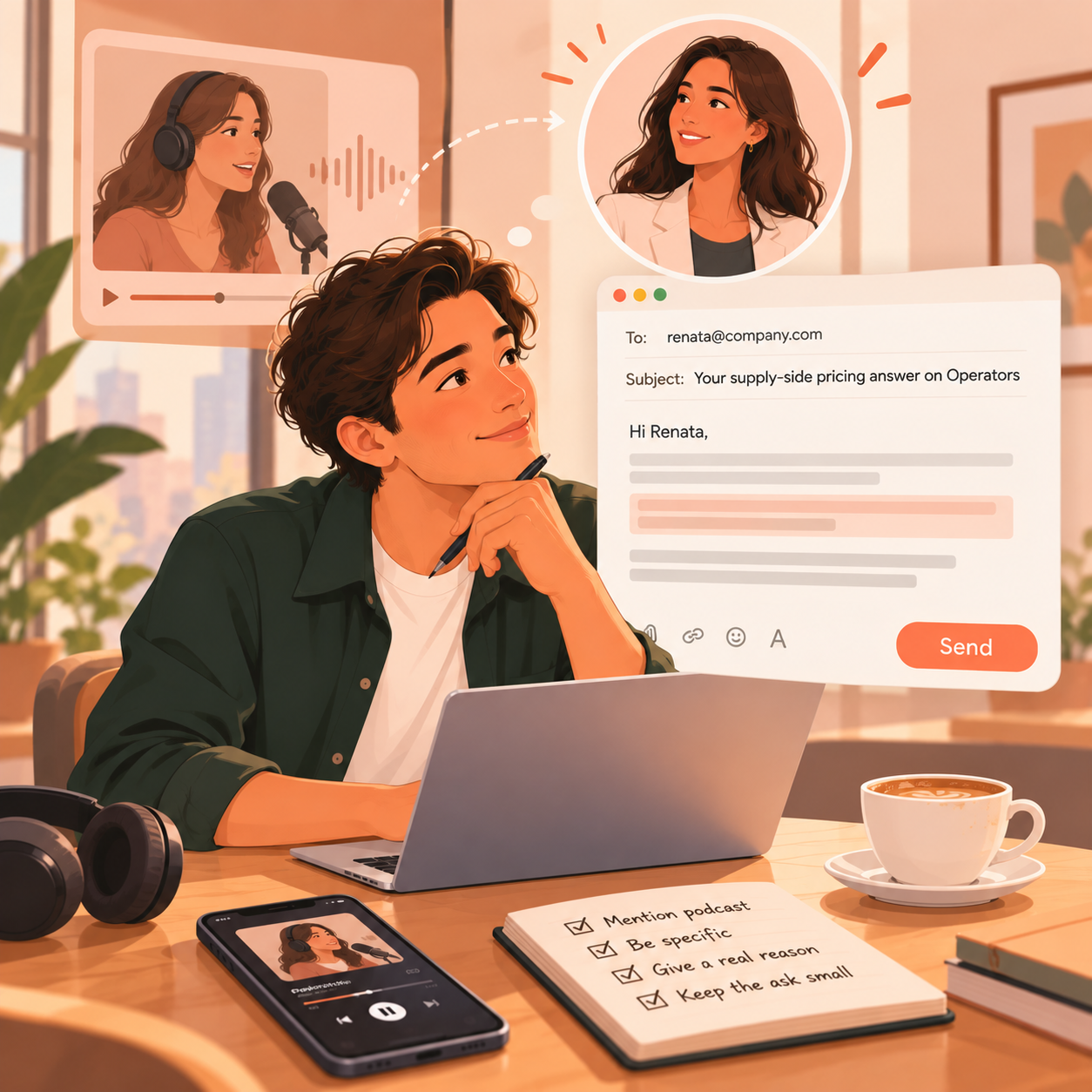
You found her through a podcast. She spent ten years building the kind of marketplace you're trying to build, and one answer she gave about pricing the supply side kept you up that night. You opened a blank email, typed "Hi, my name is," and stopped. Learning how to introduce yourself in an email starts with noticing why that sentence feels wrong.
It feels wrong because it's about you, and she hasn't been given a reason to care about you yet. Your name is in the From field already. The first line has a different job.
A self-introduction email is a short, first message to someone who doesn't know you. It works when the opening line shows why you're writing to this person specifically, the body gives one honest reason, and the ask is small enough to say yes to in a few seconds.
Busy people triage email from the preview pane. They see your name, your subject line and roughly the first sentence. If that sentence is "My name is Daniel and I'm the founder of," they have learned nothing they couldn't see already.
Open instead with the thing that connects you to them. Something they made, said, decided or wrote. Be specific enough that the sentence could only have been written to them.
Generic: "I'm a big fan of your work."
Specific: "What you said about paying suppliers to stay for their first year and a half made me rethink our whole launch plan."
The second version proves attention, and attention is the scarcest thing in a cold inbox. It also tells her immediately what you want to talk about, which saves her the effort of guessing.
When a friend emails, the relationship does half the work. A stranger has nothing to go on except what is in front of them, so every sentence either answers "why me, why now" or makes the email easier to skip.
That cuts both ways, and the good half is underrated. Experts rarely get thoughtful questions about their own work from people who have actually engaged with it. Most of what lands in their inbox is a pitch, a request for a favor, or a "pick your brain" with no brain-picking question attached. A specific, well-informed note from someone they've never heard of is unusual enough to be a small pleasure to read.
The fear that stops people from sending one is usually the fear of being a nuisance. A nuisance email is vague and open-ended. A good one is neither.
After the first line, explain why you are writing now. A real reason is specific to your situation and specific to their expertise. "Would love to pick your brain" only looks like a reason. "We have to decide by the end of the month whether suppliers pay from the start, and you have actually tested that" is a reason.
If a mutual contact is part of your reason, describe the connection at its real strength. "Priya suggested I write to you" implies she endorsed the email, so only say it if she did. "Priya and I worked together at Marlow" is a fact you can state without asking anyone. The difference matters, because people do check, and an overstated referral costs you and the person you named.
We've written about finding a genuine reason to get in touch with people you already know. With strangers the bar is higher, because they have no relationship to fall back on.
Then give one line of who you are, framed by relevance to them. Not your whole background. Only the part that makes the conversation make sense.
The ask is where most cold emails overreach. A 45-minute call with a stranger is a big ask. A 15-minute call, or a single question answered by email, is a small one.
Make it easy to say yes in one reply. Make it easy to say no without guilt. A line like "If you're swamped, no reply needed" lowers the social cost of declining, which counterintuitively makes a yes more likely.
Each of these is written as a person would send it. Read the reasoning, then write your own. Copying the words won't help; copying the structure will.
Asking an expert one specific question:
Subject: Your supply-side pricing answer on Operators
Hi Renata,
Your answer on the Operators podcast about subsidizing the supply side for the first 18 months changed how I'm thinking about our launch.
I'm building a marketplace for commercial kitchen equipment rental, and we're deciding this month whether to charge suppliers from day one. You're one of the few people who has actually run that experiment at scale.
Would you be open to 15 minutes in the next couple of weeks? If a call is too much, even a one-line answer by email to "what would you do differently?" would be gold. And if you're swamped, no reply needed.
Daniel
Why it works: the first line is unmistakably for her, the reason has a deadline, and the ask comes in two sizes.
Introducing yourself to a peer in your new city:
Subject: New to Denver, also running a design studio
Hi Marcus,
I saw your talk at the AIGA chapter meetup last month, the one about pricing brand work by outcome instead of hours. I moved my studio to Denver from Portland in the spring and I'm slowly getting to know the local design scene.
I'd like to buy you a coffee sometime and hear how you built your client base here. I'm also happy to share what's been working for us with tech clients, if that's useful to you.
Tomás
Why it works: it signals a peer relationship rather than a favor, and it offers something back in the same breath.
Writing to someone at a company you want to partner with:
Subject: Logistics data for your rural delivery pilot
Hi Aisha,
I read your post on the challenges of last-mile delivery in rural Texas. We've spent two years mapping exactly those routes for agricultural suppliers, and some of what we've learned might be useful for the pilot you described.
I'm not trying to sell you anything on this email. If it would help, I can send a two-page summary of what we've found about delivery windows in low-density counties. If it sparks something, we can talk.
Grace
Why it works: it gives first, with a concrete offer that costs her nothing to accept.
Following up on a brief moment you shared:
Subject: From the hallway after the fintech panel
Hi Chris,
We spoke for about two minutes after the panel on Thursday, right before you were pulled into another conversation. You mentioned you were looking for someone who had built compliance tooling for credit unions. That's most of what I did for the last five years.
I don't want to assume anything, but if that search is still open, I'd be glad to tell you what I learned. Either way, it was good to meet you.
Nadia
Why it works: it anchors a fleeting meeting to a specific moment so Chris can place her.
It's tempting to generate cold intros at volume. Resist it. Strangers read your email for signals that a human made a choice to write to them. An email that reads as generated tells a stranger nobody made a choice. Our piece on AI-generated outreach explains what still gets a reply.
Goodword surfaces the details you already know about someone, so your first email sounds like you were paying attention. Start your free trial.
Before you write a cold email at all, check whether you even need to. Often someone in your network already knows the person and would happily introduce you, which beats any cold email. Goodword can show you those paths across your contacts, and our guide to using your professional network before an opportunity passes explains why that warm route is so often missed.
Silence is not rejection. People miss emails, travel, get sick and forget. Wait about a week, then send one short follow-up that adds something new, such as a sharper question or a relevant link. After that, let it rest.
Keep the follow-up in the same thread so she can see your original note without searching for it. What you shouldn't do is send the same email again with "bumping this to the top of your inbox." It reads as impatience, and it doesn't give them a new reason to answer.
A cold self-introduction is an act of trust in a stranger. Earn the first sentence, give them a reason that is really yours, and ask for something small. More often than you'd expect, a stranger who gets that kind of note is glad you wrote.
When you're ready to reach the right people with context in hand, see what Goodword does in 14 days.
Keep it between 80 and 150 words, which is about what fits in a preview pane and one screen on a phone. A stranger should be able to understand who you are, why you're writing and what you're asking in under thirty seconds. Cut background that doesn't explain why this conversation makes sense.
Usually not. Attachments from unknown senders are often treated with suspicion and can trigger spam filters. If your background matters, give one relevant line in the email and link to a profile or portfolio instead.
Yes, and those are some of the best starting points, because you have something specific to reference. Mention the exact idea that stuck with you rather than general praise. It shows real attention and gives them an easy way into the conversation.
There's no reliable magic hour, so focus on not landing in a pile. Sending during the recipient's working morning, early in the week, avoids the weekend backlog. A specific, well-written email will do more for your reply rate than any send time.
Be even more specific and even more brief. Senior people get the most requests, so a precise question with a clear reason and an easy out stands out. Offer to work entirely around their schedule, and make it clear you'll accept a short email answer instead of a call.