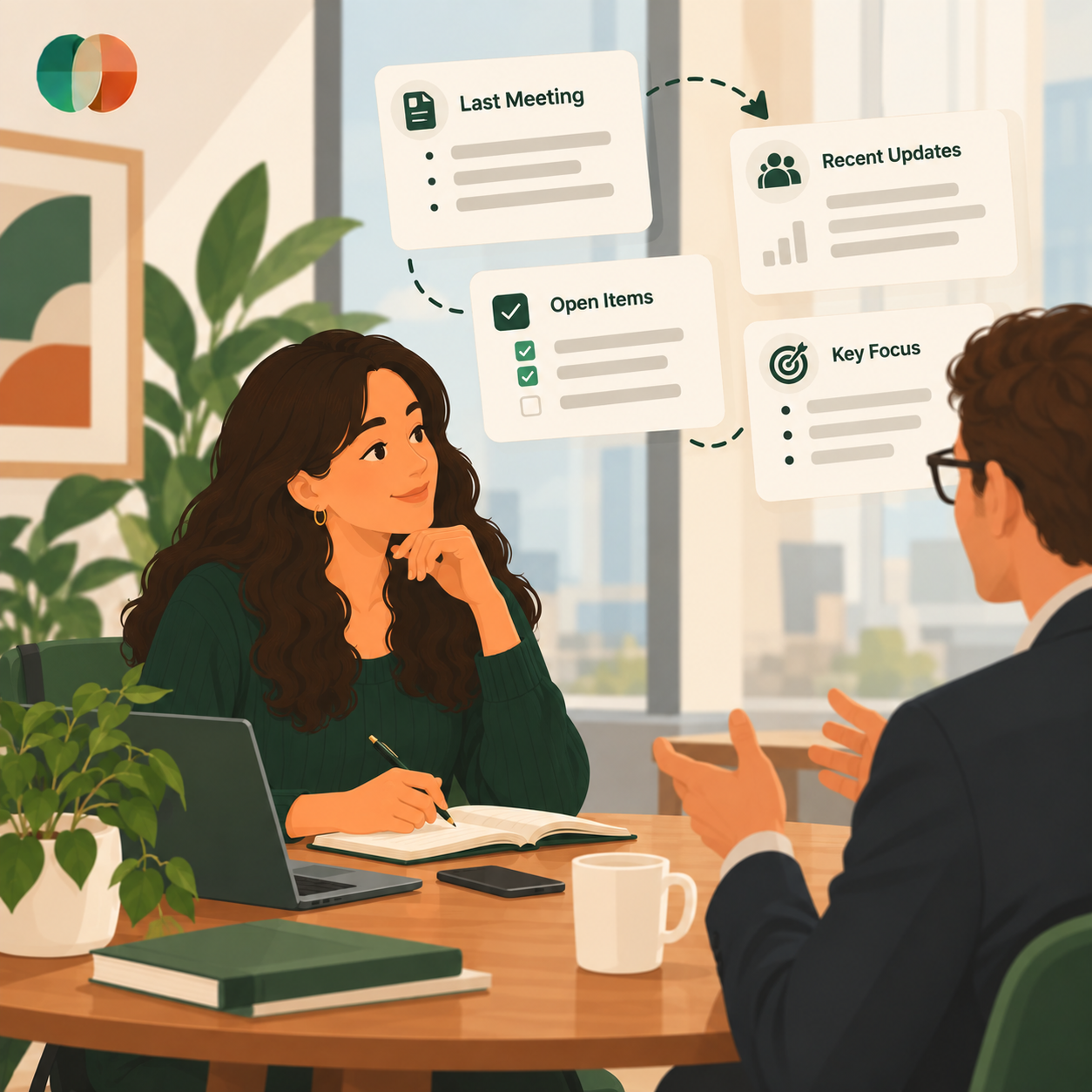
Most people prepare for a repeat meeting by reviewing the agenda. Then they walk in and blank on the one thing the client told them last time that mattered most.
The best way to prepare for a client meeting with someone you have met before is to review the relationship first: what you discussed, what you promised, what has changed for them, and what they cared about most. Ten focused minutes on that context can change the whole conversation.
Start with your own record of the last conversation, because it holds the context most people skip. The agenda tells you what this meeting is about. Your notes tell you who you are meeting and where you left off.
Relationship context is the background that makes a conversation personal: what someone is working on, what they worry about, what they asked for, and what you agreed to do next. It turns a scheduled call into a continuation of something already in progress, and losing it has a real cost to your career.
Open whatever you wrote after the last meeting and read it slowly. Look for names, numbers, and phrases the client used. If they called a project "the migration" or a goal "getting off the old system," use their words, since familiar language signals that you listened.
Memory fades faster than most people expect. In the 1880s, psychologist Hermann Ebbinghaus tested himself by memorizing lists of nonsense syllables and found that much of the effort he had invested was lost within hours to a day. A 2015 replication produced a similar curve. Real conversations are more meaningful than nonsense syllables, so the exact rate will differ, but a meeting from six weeks ago has had plenty of time to blur.
If your notes are thin, check the other places context lives: the calendar invite, the email thread before and after the meeting, and any shared documents. Together, these sources often rebuild more of the conversation than you expect.
Next, list every loose end. Include questions the client asked that you did not fully answer, materials you said you would send, and introductions you offered to make.
Open loops shape how a client sees you. A forgotten promise may be the first thing they remember, even if they never mention it. Walking in aware of it lets you address it on your terms.
Sort the list into two groups:
The second group deserves a plan before the meeting starts, even if that plan is a single honest sentence.
Finally, pick out the one or two things the client cared about most. Look for moments where their tone changed: a deadline they stressed, a boss they needed to impress, a risk that kept coming up.
These priorities tell you what to pay attention to now. A consultant who remembers that a client was nervous about a board review in March can open by asking how it went. That question shows you tracked what was at stake for them, which a summary of deliverables cannot do.
Your notes describe the client as they were. Before the meeting, find out where they are now, because roles, budgets, and priorities shift between conversations.
The person you met may have new goals, new pressures, or a new boss. Walking in with old assumptions makes you sound out of touch, even if your notes are perfect.
Look at what the person has said or shared recently: their LinkedIn activity, recent emails, and posts they wrote or reshared. A new title, a team announcement, or a conference talk all hint at what is on their mind.
Ask yourself one plain question: if this person had to name their top concern this quarter, what would it be? Your answer may differ from last time. Plan the conversation around the current answer.
Company news shapes the person's day, even when it doesn't mention them by name. Scan for funding rounds, leadership changes, layoffs, acquisitions, product launches, and earnings results.
A change at the company level often explains a change in tone. A client who was eager to expand last spring may be cautious after a hiring freeze. Knowing that ahead of time helps you adjust your expectations and your questions. Whether you use software or a quick search, the goal is the same: arrive knowing what shifted.
Other people on your team may have talked to the client since you did. A short message to a colleague ("Anything I should know before my call with Dana on Thursday?") can surface a support issue, a pricing conversation, or a complaint you would otherwise hear for the first time in the meeting.
This step is easy to skip and costly to miss. Many clients see your company as one relationship. If they told your colleague something important, they may expect you to know it.
Context helps only when you use it, so turn your review into three small things you bring into the room. Together they make the meeting feel like a continuation.
A callback is a short reference to something the client shared last time. Choose one. It might be a work detail ("How did the vendor review go?") or a personal one they offered freely ("Did your daughter like her first week at college?").
One callback works better than five. A single specific memory feels like attention. A string of facts recited at the start feels like you studied a file. Use personal details only when the client brought them up and seemed glad to share them.
Prepare one question that pushes the work to its next stage. Good forward questions connect what you know to what needs deciding:
These questions show that you remember the past and care about the next step. They also bring up blockers early, while you still have time to help.
Decide before the meeting what a good result looks like for the client and for you. Write it in one sentence, such as "We agree on the pilot scope and a start date."
A useful meeting usually ends with a clear next step both people own. If your goal helps only you, the client will likely feel it. Frame the outcome around progress on their problem, and your own goals usually follow.
Preparation for your next meeting starts the moment this one ends. Meeting follow-up is where context gets saved or lost.
Within a few hours, write down what changed: new priorities, decisions made, names mentioned, and anything personal the client shared. Keep it short, five or six lines you will read next time.
Notes written the same day hold detail that notes written a week later lose. Store them somewhere you will find before the next call, linked to the person and not buried in a folder of meeting minutes. A debrief tool that lets you type or talk through the conversation can lower the effort, though the judgment about what matters still belongs to you.
Send what you promised, when you promised it. If you said "by Friday," send it by Friday. If you cannot, tell the client before the deadline passes. Reminders pulled from your meeting notes can prompt you about commitments you made.
Follow-through builds trust between meetings. Each kept commitment gives the client a small reason to believe the next one, and a follow-up system that fits a busy week means your next prep session starts with a clean list of open items.
As a rule of thumb, ten to fifteen minutes covers most repeat meetings. Spend more when the stakes are high, when a lot has changed, or when months have passed since you last spoke.
Review your notes from the last conversation first, then any open promises or questions. After that, check for recent changes to the person's role and their company.
Rebuild the context from the email thread, the calendar invite, and shared documents. You can also ask a colleague who was involved, or open the meeting by asking the client what has changed since you last spoke.
Open with one specific callback to your last conversation, such as asking how a project or event they mentioned turned out. Then briefly confirm what you hope to cover so the client can add their own priorities.
Raise it early and plainly, before the client does. Say what you committed to, give a short reason for the delay without excuses, and name a new date you are confident you can meet.
Your next meeting goes better when the context from the last one is easy to find. Goodword helps you capture what each person said, track what you promised, and pick up the conversation where it left off. Start your free trial.

.svg)





.png)