Two names have been sitting next to each other in your head for a week. A founder you advise needs someone who has run operations at a multi-site dental group, and you had dinner last month with exactly that person. Writing the email introduction would take four minutes. You still haven't sent it, because some part of you knows that a lazy intro can cost you more goodwill than no intro at all.
That instinct is correct. An introduction spends trust that belongs to you and to both people you are connecting. Done well, it is one of the most generous things a professional can do. Done carelessly, it hands two busy people a chore with your name on it.
An email introduction is a short message in which you connect two people who don't know each other, explain why they should talk, and then step out of the way. The best ones are asked for in advance, specific about the overlap, and easy to decline.
When you introduce two people, each of them reads the email as a small claim about your judgment. You are saying: I thought about you, I thought about them, and I believe twenty minutes together is worth more than twenty minutes of whatever else you had planned.
If you are right, both people credit you. If you are wrong, both people learn something about how much your next intro is worth.
You also hold information neither of them has. Dana doesn't know Priya exists, and Priya has no idea Dana spent six years solving her exact problem. You are the only person who can see both sides of the match, which is why your intro carries weight, and why the weight is yours to protect.
The double opt-in introduction is the single habit that separates thoughtful connectors from people who forward names around. Before you put two people on the same thread, you ask each of them, separately, whether they want the introduction.
It feels slower. It saves everyone time.
Usually you only need a formal opt-in from the person with less reason to say yes: the investor, the senior executive, the expert being asked for their time. The person who requested the intro has already opted in by asking. When the value runs both ways, check with both.
A good opt-in note gives the other person enough to decide in one read, and an honest way out. For example:
Hi Dana, quick one. I advise a founder, Priya Nair, who is building scheduling software for dental groups with five to fifty locations. She's trying to understand how ops leaders decide which tools get rolled out across sites, and I immediately thought of your time running operations at Brightline. Would you be open to a 20-minute call with her? Completely fine to say no, I haven't mentioned you to her yet.
Notice what that last sentence does. Dana can decline without anyone's feelings being hurt, because Priya doesn't know she was asked. That protection is what makes people comfortable saying yes to you again later.
Two more things belong in the opt-in. If the conversation has a commercial purpose, such as a consultant hoping for an engagement or a founder raising money, say so plainly; "swap notes" sets the wrong expectation. If you can't describe the requester's situation well in a sentence or two, ask them for a short blurb you can forward, then trim anything sensitive or anything you can't vouch for yourself. And if your sense of what someone needs comes from a conversation months ago, check it still holds before acting on it. The role they were hiring for may already be filled.
If you are on the other side of this and want someone to make an intro for you, we've written separately about requesting a warm intro in a way the connector can act on in one sitting.
Once both people have said yes, the intro itself should be short. Most bad introductions fail in the same place: they describe each person by job title and leave the reader to work out why they are talking.
Titles tell people what someone does. The overlap line tells them why this particular conversation is worth having. It is the most important sentence in the email.
Weak: "Dana is VP of Operations at Brightline. Priya is the founder of Chairside."
Stronger: "Dana rolled out three new systems across 22 dental offices and has strong views on what makes staff adopt a tool or let it gather dust. Priya is building exactly that kind of tool and wants to hear the unvarnished version."
The second version gives each person a reason to be curious about the other. It also gives them a natural first question, which removes the awkward opening minutes of the call.
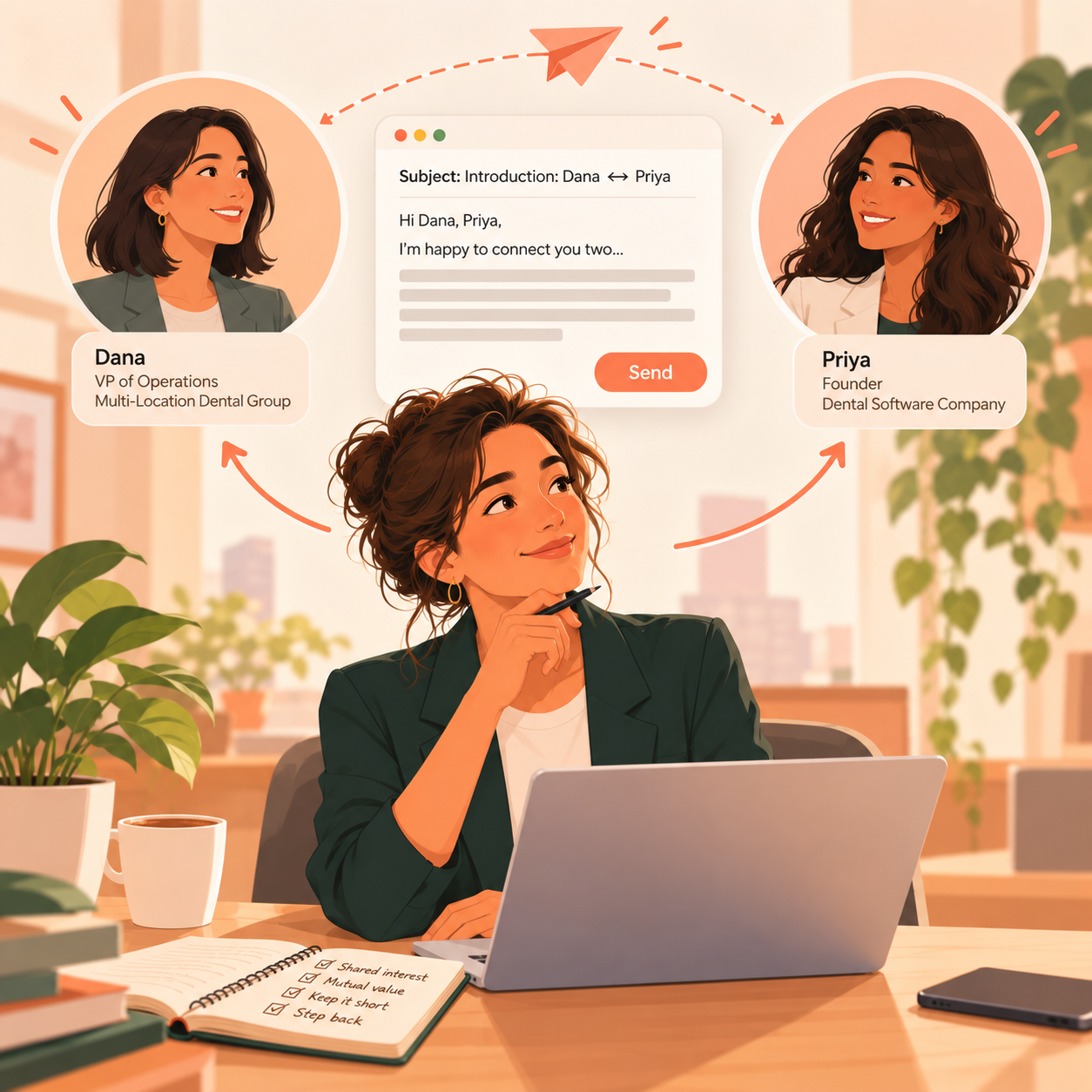
Here is what the full email between two people might look like after Dana has opted in. Put the person who gave the favor first in the greeting, and let the email make clear who is helping whom.
Subject: Dana <> Priya (dental group ops)
Dana, Priya, I'm happy to finally connect you two.
Dana, Priya is the founder of Chairside, which helps multi-location dental groups manage scheduling across offices. She's early, thoughtful, and trying to learn how ops leaders actually decide what gets rolled out.
Priya, Dana ran operations at Brightline for six years and took them from 8 to 22 offices. She has opinions about what makes front-desk teams adopt new software, and she's generous with them.
Dana has kindly offered 20 minutes. Priya, I'll let you take it from here and find a time that works for her.
Thank you both. I think you'll enjoy each other.
Just as important is what the email leaves out. Priya told you privately that her runway is short; that stays between you. Share only what each person would be comfortable seeing forwarded.
The email does four jobs in about 120 words. It names both people, gives each the context they need, states the specific ask, and hands the logistics to the person who benefits most. The connector is out of the way by the last line.
That handoff matters. If you leave scheduling ambiguous, both people wait for the other, and the thread dies with good intentions all round.
The no-pressure line is the second most important sentence in the process, and it belongs in the opt-in, not the final intro. By the time both people are on the thread, a polite exit becomes awkward because the other person is watching.
Some people will decline. That is the system working. A no to an opt-in costs you nothing, while a yes extracted under social pressure produces a reluctant call, a vague follow-up, and a slightly lower opinion of you.
When someone declines, close the loop with the requester without naming names if you can avoid it:
I checked with the person I had in mind and the timing isn't right for them. Let me think about who else might be useful. In the meantime, have you talked to anyone at the regional dental associations?
Then, if you can, offer an alternative. The goal was to help, and help can take other forms.
The people others think of as super connectors are rarely the ones who know the most names. They remember what each person needs, they notice when two needs line up, and they follow through. Our piece on what makes someone a super connector goes deeper on those habits.
That memory is the hard part. A month after the intro, will you remember that Dana gave her time, or that Priya promised to send an update? If the answer is no, you lose the best part of making intros, which is learning which ones worked and building on them.
Goodword notices when two people in your network should meet, and keeps the reason in view so the intro takes minutes. Start your free trial.
Goodword can also suggest introductions based on what's happening in your world, and in Claude, ChatGPT or Gemini it can draft the intro from what you already know about both people. The judgment stays yours. The remembering doesn't have to.
Introductions are one of the purest forms of giving first. You spend a little of your time and trust, and two people gain something neither could have gotten alone. We've made the argument for giving first at more length, and introductions are its cleanest example.
The connector rarely gets an immediate return. What you get instead is a reputation as someone whose introductions are worth taking, and that reputation is what makes your next ask land. If you want a single place to see who you know and where the useful overlaps are, the Goodword desktop app brings your contacts, calendar and LinkedIn together for exactly that.
Ask before you connect, write the sentence that explains why these two, and leave a graceful way out. After that, the best thing a connector can do is get out of the way.
When you're ready to make more intros without losing track of who needs whom, begin a 14-day trial of Goodword.
A double opt-in introduction means you ask each person privately whether they want to be connected before you send the email to both. It protects the busier person from an unwanted obligation and lets them decline without embarrassment. In practice you often only need to ask the person being asked for time, because the requester has already said yes by asking.
Address the person who is doing the favor, or the more senior person, first in the greeting and the body. This signals respect for their time and makes it clear who is helping whom. Then explain the other person's context so the senior person can see why the conversation is worth it.
Keep it to the two names and a short reason, for example "Dana <> Priya (dental group ops)". Both people will search their inbox for this thread later, so plain and specific beats clever. Avoid vague lines like "Intro" on their own, which get buried.
Aim for roughly 100 to 150 words. Each person needs a sentence or two of context, one overlap line, and a clear next step. Anything longer usually means you are pasting resumes instead of explaining why the two should talk.
A light check-in a few weeks later is welcome, especially with the person who received the help. Ask whether the call happened and whether it was useful. The answer teaches you which intros are worth making again, and it reminds both people that you cared about the outcome.