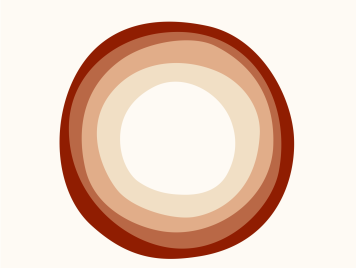
Count the people outside your team and your family that you actually spoke with last week. For most busy professionals the list is short, and it is mostly the same names as the week before. That repetition is the Dunbar number showing up in your calendar. You have far more contacts than you can keep warm, and your attention has already sorted them into rings whether you planned it or not.
The Dunbar number is the roughly 150 people a person can keep a genuine, individual relationship with at one time, arranged in layers of about 5, 15, 50 and 150 that grow larger and less intimate as they move outward.
The famous figure is the least useful part. The layers explain why some relationships compound while others fade.
Robin Dunbar, the Oxford evolutionary psychologist, started with monkeys and apes. In his 1992 paper on neocortex size and primate group size, he compared species and found that "group size is found to be a function of relative neocortical volume, but the ecological variables are not." His argument was that the number of neocortical neurons limits how much social information an animal can process. Extrapolate the primate line to the size of the human brain and the equation predicts a group of about 148, which became the rounded 150.
A prediction from brain size is one thing. Dunbar and Russell Hill then tested it on people with a charming method: Christmas cards. In their 2003 study in Human Nature, 43 respondents logged every card their household sent, 2,984 cards in total, along with who lived in each receiving household and how emotionally close they felt to it. The maximum network size averaged 153.5 people, remarkably close to the prediction. For the subset of people who were contacted directly, the mean was 124.9.
A card is a decent proxy for a relationship you still bother to maintain. Read the number that way: people you know as individuals, with shared history, whom you could contact without an excuse.
The more surprising result came later. When Wei-Xing Zhou, Didier Sornette, Hill and Dunbar ran a fractal analysis across many datasets on human grouping, they found that people do not form groups of any size at random. Their 2005 paper in Proceedings of the Royal Society B reports "a discrete hierarchy of group sizes with a preferred scaling ratio close to 3."
Alistair Sutcliffe, Dunbar and colleagues later summarized the shape in the British Journal of Psychology: each layer increases relationship numbers by roughly a multiple of three, giving the familiar 5, 15, 50 and 150. Moving outward, each ring holds more people, with lower intimacy and less frequent contact.
The pattern also shows up in behavioral data, where nobody is filling in a survey. Pádraig Mac Carron, Kimmo Kaski and Dunbar clustered mobile phone call records in a 2016 paper titled Calling Dunbar's numbers. The most common four-layer solution came out at about 4.1, 11.0, 29.8 and 128.9 contacts, slightly smaller than the classic figures. When the authors forced every user into four layers, each one averaged about 3.3 times the size of the one inside it.
The layers are cumulative. Your 15 includes your 5, and your 150 includes everyone inside it. There is also only one set. You do not get 150 friends and another 150 work contacts; your partner, your siblings, your oldest friend and your best client all draw on the same budget. In professional terms the rings tend to look like this.
The inner five. The people you would call on a bad day. For a founder this is often a cofounder, a partner and one or two friends who understand the work.
The fifteen. The people who would hear your real news before it went public. A former manager you still trust, a peer you swap honest numbers with, the investor who answers on a Sunday.
The fifty. Your active working circle beyond your company: people you collaborate with, refer to, and catch up with a few times a year. This is where most professional opportunity moves.
The 150. People you know by name and story. You would recognize their situation if they wrote to you, and they would take your call.
Beyond that sit acquaintances: names, faces and LinkedIn connections you could not describe in two sentences.
The layers exist because relationships cost time, and time is finite. Sutcliffe and colleagues describe it as a trade off: the benefit each layer provides levels off, while the cost of maintaining relationships rises roughly in proportion to their number. The layered structure is what you get when people balance those two curves.
You can see the budget in the data. A team including Jari Saramäki, Sam Roberts, Felix Reed-Tsochas and Dunbar followed 24 young adults for 18 months as they moved from school to university or work, combining surveys with their phone records. As the Oxford Martin School summary of their 2014 PNAS study explains, each person had a stable "social signature," a consistent way of spreading calls across their network. When new people arrived, old ones were replaced or received fewer calls. In the paper's own figures, the top three contacts took around 40 percent of calls for men and 48 percent for women.
The implication for working life is blunt. You do not add someone to your inner layers without someone else getting less of you. Every new relationship is paid for by an existing one.
Watch how ambitious people spend networking energy. The inner five get attention by default, because they are in your life every day. The outer ring gets attention by design, because events, conferences and connection requests are visible and feel productive.
The fifty gets whatever is left, which is usually nothing.
That is costly, because the fifty is where professional value concentrates. These are people close enough to trust you and to know what you are good at, yet far enough away to sit in different companies, industries and conversations. When a role opens, a client needs a referral or an investor asks who else to meet, the person they think of tends to come from someone's fifty. Goodword's post on why weak ties are a career advantage covers the research on the outer edges; the fifty is where weak ties graduate into something that reliably produces.
Closeness and contact also move together. In a 2011 study of 251 women, Sam Roberts and Dunbar found that greater emotional closeness went with shorter time since last contact. Hill and Dunbar's Christmas card respondents contacted their very closest people weekly. When contact stops, the relationship drifts outward a ring at a time, and you rarely notice until you need it.
Write down your fifteen. Most people find two surprises: someone who belongs there and has drifted, and someone who is there by habit and no longer matters to the work you are doing now.
Choose your fifty instead of inheriting it. Look at the next year: the raise, the hire, the move into a new market. Which thirty to fifty people would make that year go better if they knew what you were working on? That list will overlap with your current fifty, but rarely completely.
Give each ring a different rhythm. Your fifteen probably needs a real conversation every month or so. Your fifty needs a meaningful touch a few times a year: an introduction, an article that made you think of them, a congratulations that shows you read the news. Your 150 needs to hear from you at least once a year, ideally with something specific. For turning that rhythm into a weekly habit, see our guide to choosing who gets your attention each week.
Let people move. A client who becomes a friend moves inward; a former colleague you no longer share anything with moves out. Both are healthy if the movement is a decision rather than an accident.
Goodword notices when someone in your fifty has gone quiet longer than usual and nudges you before they slip a ring. Start your free trial.
Dunbar's number has critics, and they are worth hearing. In 2021, Patrik Lindenfors, Andreas Wartel and Johan Lind reran the primate brain analysis with newer data and statistical methods in Biology Letters. Their 95 percent confidence intervals ran from about 2 to 520 people, and they concluded that a precise human estimate cannot be made from the available methods and data.
That critique lands on the single number, and fairly so. As of October 2026 it remains the most cited challenge to the figure. Some people sustain far more than 150 relationships; others hold fewer and are perfectly well connected.
The layered structure is harder to dismiss, because it keeps appearing in data that has nothing to do with brain volume, from holiday cards to phone logs. For professional purposes the exact count matters less than the shape. Your attention is finite, it clusters into rings, and the ring you neglect is usually the one that would have helped you most.
Knowing your layers is less about limits and more about honesty. You cannot be close to everyone, so the question is whether the people closest to you are there because you chose them. A network built that way compounds, the same way focusing on quality over quantity does, and it is the kind of network Goodword was built to keep in view.
Goodword brings everyone you know into one view, with context on each relationship, so the fifty you choose stays chosen. Take a free 14-day look.
No. The 150 figure is an average with wide variation between individuals. Hill and Dunbar's Christmas card study found an average maximum network of 153.5, but the number of cards people sent ranged from 11 to 149, and a 2021 reanalysis argued no precise human figure can be derived from primate brain data. Treat it as a typical size and focus on the layered pattern, which holds up better.
Yes, and they take up real room. Roberts and Dunbar found that people with large kin networks had longer gaps since last contact with both relatives and friends, which suggests family competes with friends for the same limited time. People from big families often have smaller friendship circles for exactly that reason.
The research shows closer people are contacted more often, with the very closest heard from weekly. A practical rhythm is weekly for the inner five, roughly monthly for the fifteen, a few times a year for the fifty and at least yearly for the 150. The exact cadence matters less than keeping each ring from going silent.
They can, and it happens all the time when people work closely through something hard, such as a launch, a fundraise or a crisis. The phone data from Saramäki and colleagues suggests that when someone moves in, someone else usually receives less contact. Moving a contact inward is a trade, so make it on purpose.
They become acquaintances: people you recognize but could not describe in any depth. They still have value as weak ties and as dormant relationships you can revive later. The cost is that without some contact, you lose the context that would make a future conversation feel natural.