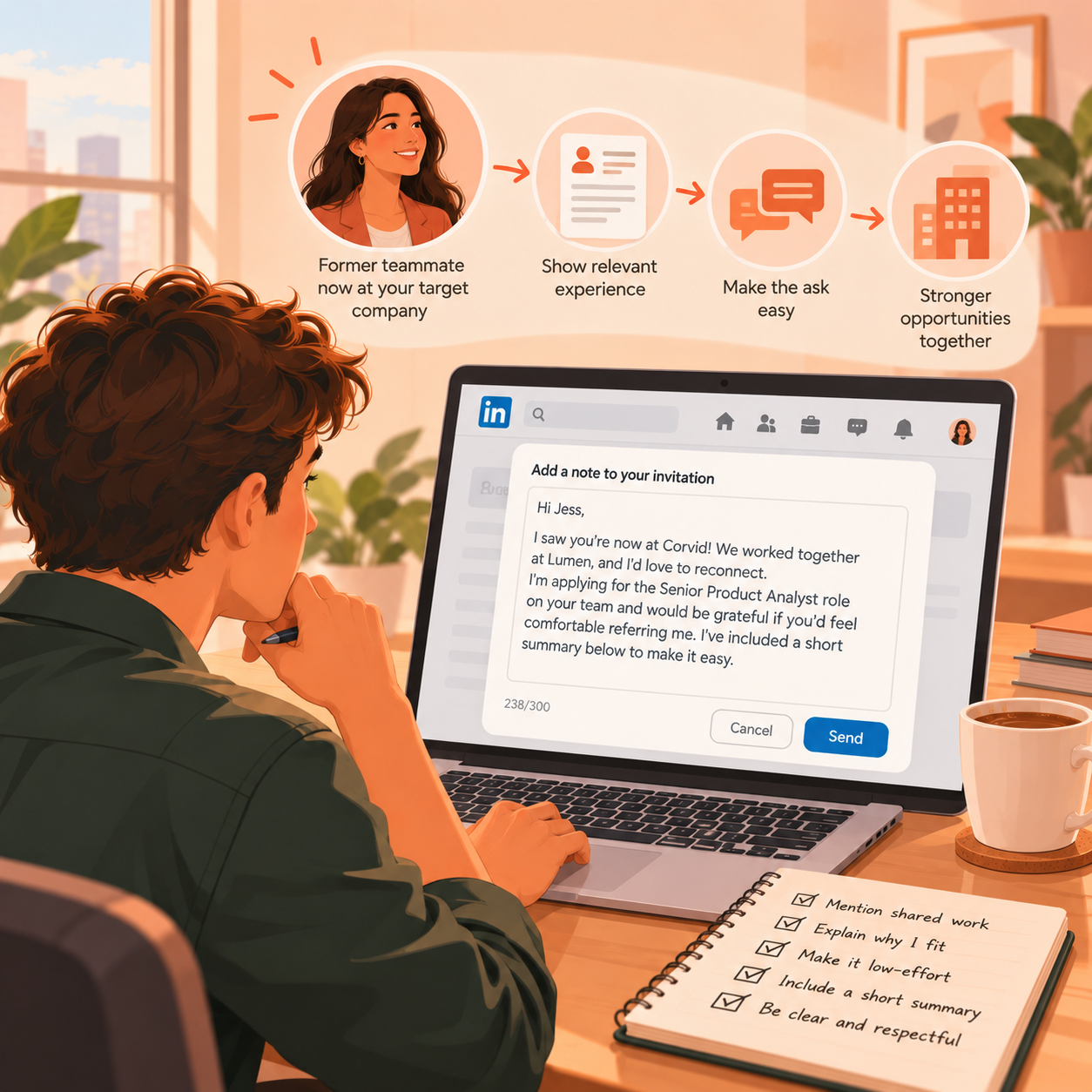
You find the perfect role at a company where a former teammate now works. You open LinkedIn, type "Hey! Hope you're well. Would you be able to refer me for this?", paste the link and hover over send. Then you stop, because you can feel how much you are asking without saying so. Knowing how to ask for a referral starts with naming what that hesitation is picking up on: you are not asking for a click, you are asking someone to lend you their reputation.
A referral is a recommendation in which someone vouches for you to a person who trusts them, and asking for one well means making that vouching as low-risk and low-effort for them as possible.
When your former teammate submits your name, the hiring manager does not just see you. They see you through her. If you turn out to be great, her judgment looks good. If you flame out, or the referral was obviously a favor, her credibility takes a small hit.
Research on hiring helps explain why that credibility matters. Stephen Burks, Bo Cowgill, Mitchell Hoffman and Michael Housman studied hiring records from nine large firms in call centers, trucking and high tech, published in the Quarterly Journal of Economics as "The Value of Hiring Through Employee Referrals". Referred applicants were more likely to be hired and to accept offers, even though their measured skills looked much like everyone else's. Once hired, referred workers were substantially less likely to quit.
The authors' analysis adds the detail that matters for you. According to the IZA Institute of Labor Economics' summary of the research, most of the advantage came from referred people being a better match for the specific job they were referred to, and the referrals that paid off most came from the firms' strongest, longer-tenured employees.
That is why your former teammate pauses. Her referral works because it carries information. If she refers people she cannot really vouch for, it stops carrying any.
The best referrer is not always the most senior or best connected person you know at a company. It is the person who can say something specific and credible about you.
That might be:
If the only person you know at the company met you once at a conference, a referral may not be the right ask. A better ask might be twenty minutes to learn about the team, with a referral as a possible outcome later. Asking for a warm introduction to someone closer to the role is another route.
Most referral asks fail by leaving out what the referrer needs to decide. They have to work out whether you are a fit, whether the role makes sense for you and what they would say. Many people let those messages sit, not because they do not want to help but because helping requires homework.
Make the decision easy. Your message should cover:
The LinkedIn message, rewritten, could look like this:
"Hi Jess, I saw Corvid is hiring a senior product analyst on the payments team (link below). It's close to what I did on the checkout redesign we worked on at Lumen, especially the pricing experiments. If you feel comfortable referring me, I've put a short summary below you could paste into the referral form. If you don't know the team well enough or it's awkward, no problem at all. I'd still love to hear how you're finding it there."
The message reminds her of shared work, so she knows what she would be vouching for. It hands her the words. It also gives her a graceful exit and an alternative ask, which makes it easy to say yes to something.
The single most useful thing you can do is draft the summary your referrer would include. Keep it short, factual and in the third person so they can paste it with light edits:
"Ravi led pricing experiments on Lumen's checkout redesign, which lifted conversion on paid plans over two quarters. He's strong on SQL and on explaining results to non-technical teams. I worked with him for two years and would happily work with him again."
Leave the last sentence for them to confirm or change. You are drafting, not putting words in their mouth.
Before you ask, it helps to remember the projects you shared and what the other person would remember about you. Goodword keeps the history of past projects and conversations with each person, so your referral ask can point to the work you actually did together. Start your free trial.
Referrals for clients, customers and partners follow the same logic, but the referrer's risk is often bigger. Recommending a consultant or vendor to a friend means vouching for months of work, money and possibly their own reputation with their boss.
Two adjustments help.
Narrow the target. "Do you know anyone who might need help with marketing?" is almost impossible to answer. "Do you know any founders who've just raised a seed round and need their first finance hire?" brings specific names to mind. The narrower your description, the easier it is for someone to scan their own network.
Make the first step small. Instead of asking for an introduction that implies a sales conversation, offer something low-risk for the person being introduced: a short call, a resource, a quick review. That makes the referrer's ask of their own contact easier too.
For founders and operators, business referrals often come from people you have helped before. That is one reason giving first tends to come back around, often through referrals you never asked for.
The hardest referral ask is the one to a former colleague you have drifted away from. It can feel like you only reach out when you need something.
Acknowledge the gap honestly and briefly, then give some real context before the ask. Something like "It's been a couple of years, which is on me" is enough. Then share what you have been doing, so they have current information to vouch for. Keep the ask itself as easy to decline as any other.
In our experience, dormant ties are often more willing than you expect, because the trust from your shared work did not expire when the messages stopped. It is one reason to put your professional network to use before an opportunity passes, instead of waiting until moments like this to reconnect.
Your referrer has now spent some of their credibility on you. They deserve to know how it went, whether or not you got the job or the deal.
Send a short note at each meaningful step: when you hear back, after interviews, when there is a decision. If you are hired, tell them. If you are not, tell them that too, and thank them anyway. Referrers who never hear the outcome are less likely to refer again, and they may wonder whether they were used.
If they helped in a big way, look for a way to return it. We have written about the help we receive and never repay, and a referral is one of the clearest examples worth closing out properly.
The first draft of that LinkedIn message was not rude. It was just incomplete. It asked your former teammate to do all the work of deciding, describing and risking, with nothing to make it easier.
The fixed version takes ten more minutes to write. It respects what a referral actually is. That respect is what makes people glad to put their name next to yours.
Goodword shows the warm paths into the company you're targeting, so you can see who is actually placed to vouch for you. See who can vouch for you.
Usually, ask for something smaller first, such as a short conversation about the team or role. A referral is a vouch, and it is hard to vouch for someone you do not know. If the conversation goes well, the person may offer to refer you without being asked.
No, as long as the ask is specific, easy to decline and respectful of the referrer's reputation. Referrals are a normal part of how hiring and business development work. What feels rude is a vague request that leaves the other person to do all the work.
Include the specific role or opportunity, a short explanation of why you fit, exactly what you are asking them to do and a ready-to-paste summary of your relevant experience. Add a clear line that makes declining comfortable. The more complete the request, the faster people tend to act on it.
Research by Burks, Cowgill, Hoffman and Housman across nine large companies found referred applicants were more likely to receive offers. Referred hires also tended to stay longer. The effect depends on the referrer being credible, which is why the right referrer matters.
Yes. Thank them right away, then keep them informed at each stage of the process, including the final result. A referrer who hears how things turned out is far more likely to help again.